Kategorie: Sachbuch (Seite 1 von 14)

Nicholas Joll: Philosophy and The Hitchhiker’s Guide to the Galaxy (2012)

Mostly exciting discussions of philosophical ideas in the Hitchhiker’s Guide

This book fulfills the expectation that all the philosophical topics which made you stop, smile and think for a moment, while reading Douglas Adams‘ Hitchhiker’s Guide to the Galaxy (and it’s follow-ups), are picked up and discussed. The topics are presented with a certain fun factor, since the authors partly tried to emulate Douglas Adam’s style of writing, and since serious philosophical problems are discussed on the background of the rather funny Hitchhiker’s world. Last but not least, the presented philosophical topics are for themselves mostly exciting, though you may have heard already of some of them.

Warning: For me, the book seemed to start rather dry and boring in its first chapters. But it gained momentum in the middle of the book and turned out to be an exciting and funny read in the end. Maybe it’s due to my own philosophical views and preferences? Anyway, if it happens that you find the book boring, keep on reading, it will change!

Some interesting topics / discussions (it is even more):

  • Is it allowed to eat animals if they give consent?
  • Is it allowed to enjoy violence if it’s only virtual reality?
  • The meaning of Life under the perspective of an infinite life / a finite life.
  • The absurdity of life and how to handle it.
  • The mere existence of God and being part of his plans is not sufficient to give meaning to our life.
  • Artificial Intelligence: Self-feeling and the relation of feeling and reason as a problem.
  • Reason does only work if we have feelings, too. (p. 137)
  • Some philosophers consider it even likely, that we exist in a computer simulation, and in fact only somewhere in the middle of a computer-simulation-within-a-computer-simulation hierarchy of nested computer simulations.
  • Some philosophers consider it possible that our world had been constructed only for the purpose of performing a certain simulation / calculation, just like the Earth in The Hitchhiker’s Guide.
  • Kurzweil’s idea of transhumanism is clearly put into question.
  • Parallel universes and multi-universes.
  • There’s also an exercise in logic.
  • The ruler of the universe as a Pyrrhonian skeptic.
  • The „Judo principle“: Instead of solving a problem directly, use the problem to solve itself! There are many well-known applications of the Judo principle in various areas of philosophy, and it is interesting to see how these well-known arguments work all along the same principle, and where the limits of the principle are.
  • Kant’s critique of pure reason as an application of the Judo principle, in answer to another application of the Judo principle by David Hume.
  • The „logic of jokes“ is closely related to the logic of philosophising, i.e. surprise, wonder, brainstorming, bringing together what seems not to belong together, etc.
  • Inspiration of The Hitchhiker’s Guide by Swift’s Gulliver’s Travels, and especially by Voltaire’s Candide.

Some of the chapters slightly overlap in their topics, since they are written by various authors, but this is not a problem since it makes you rather think twice about a problem from a slightly different perspective. All chapters provide useful and not too many hints to literature. There is a glossary of philosophical terms, too, and various indices on topics within and without The Hitchhiker’s Guide to the Galaxy.

Missing or insufficiently discussed are e.g.:

  • Political philosophy in The Hitchhiker’s Guide.
  • Relation of religion to politics, or to other-believers, or to non-believers, and vice versa.
  • Development of human society step by step.
  • The event of changing mind; religious reforms.

Bewertung: 4 von 5 Sternen.

(Erstveröffentlichung auf Amazon am 10. März 2019)

Stephen P. Kershaw: A Brief History of Atlantis – Plato’s Ideal State (2017)

Buy this book – although it is not fair to its readers

A certain part of a scholar’s life is dedicated to „ghost busting“, i.e. to debunk wrong concepts existing out there, in the coarse reality of popular books, colourful magazines, and the vastness of the internet, and to provide the basis for a better understanding of reality at an academic level to all who are interested. This had been the basic idea of this book, possibly. And who would not support such a noble purpose? But you can exaggerate everything by going to the other extreme.

This book is deeply disappointing. After Vidal-Naquet’s one-sided book from 2005, written against all sorts of Atlantis supporters without exception, there was a chance to provide a more balanced view to the interested public, and to include new arguments. But the opportunity has been missed again. And like Vidal-Naquet’s work, this book is not fair to its readers: The readers are manipulated by all sorts of unacceptable omissions, oversimplistic arguments, and misleading wordings, as will be demonstrated in the following. Furthermore, the book contains many mistakes.

Manipulative Style

The manipulation starts right on page 1 in the very first line. There, the Atlantis story is addressed as a „myth“ without further ado. But if one thing is sure, then that Atlantis is not a myth. Because Atlantis is presented in Plato’s dialogues as a true story, not as a myth. Even if it is an invention, it is still not a myth. Atlantis is presented as the opposite of a myth. The story allegedly came from Egypt where it had been preserved in written form over a very long time thanks to the continuity of the Egyptian civilization. The claim of Plato’s dialogues is, that Egyptian texts provide a window into the past, bridging the time of which the Greeks only know myths, or nothing at all. And it is true: Egyptian texts do indeed tell such stories of ancient times, and still today Egyptologists are able to tell a lot about other countries and peoples of which information has been preserved in ancient Egyptian texts. But this book stubbornly ignores this reasonable claim which deserves to be taken seriously and discussed. This book just goes on right from page 1 to press for the idea that the Atlantis story is a myth, time and again throughout the whole book. Time and again the question is raised why there is no connection between traditional Greek mythology and the Atlantis „myth“. A question for which there is no legitimate reason to be asked.

And right on page 1, the Atlantis story is called a „tale“. The word „tale“ is explicitly presented as the translation of the Greek „logos“ without further ado. But this is plainly wrong. The word „logos“ has to be translated with a neutral word such as „story“ or „narration“, here, whereas the word „tale“ has a clear inclination towards a fabulous and imaginative meaning. Surprisingly, the book itself reveals the correct translation of „logos“ with neutral words such as „account“ or „story“, but only in footnote 38 on page 361. Why hiding away the correct translation, while at the same time penetratingly talking of the „Atlantis tale“ throughout the whole book?

The myth … the tale … the myth … the tale … – it is really annoying, how this book tries to hammer down its message into the brains of its readers. The book really seems to be written to „program“ the readers: Time and again, chapters begin with a special section in which some mythical and fabulous context is presented, or any kind of chaos and confusion is produced concerning the allegedly correct understanding of myth and truth. By putting Atlantis time and again in such contexts – in which it does not belong – the reader is step by step led to develop a biased perspective on the subject. You feel like brainwashed after a while.

So, the very first chapter does not deal with Atlantis at all, but presents all sorts of mythical and fabulous stories about far-away lands and towns in Greek literature. But the book does not mention and discuss the following things:

  • Atlantis is no myth and cannot be put into the context of myths.
  • Atlantis is no vague memory but presented as factual story from a written historical tradition with clear details, and anchored in known reality (Sais, Pillars of Hercules, geology of Athens). In antiquity, there was even no discussion about the location of Atlantis, because the (alleged) location of Atlantis is clearly defined, too.
  • Atlantis is no „paradise“, and no „wondrous“ island, as the book repeats time and again. There are no magical „wonders“ in Atlantis, and in the works of Herodotus you find bigger buildings, larger armies, similarly fertile land, and older countries; and Herodotus was a serious writer, not a myth-maker.
  • Some of the presented fabulous lands and towns are not fabulous but real. Only some of their features are fabulous, or distorted. This could well be the case with Atlantis, too, but why does this book not discuss this?
  • Some of the allegedly „mythical“ aspects of the Atlantis story are clearly not meant to be mythical by Plato, because Plato himself believed them. These are things such as a cyclical model of history, an age of Egypt of 10000 years and more, periodic natural disasters (mentioned only in footnote 43 on page 362), that good climate generates best people at the same place time and again (mentioned only in footnote 74 on page 368), or that there is no quarrel among gods.

Historical-critical approaches?

It is a major failure of this book to omit a serious discussion of historical-critical approaches. The word „historical-critical“ does not appear once in the whole book. Historical-critical approaches such as Zangger’s hypothesis concerning Troy, or the hypotheses concerning the Minoan civilization, are rejected in this book by the simplistic opinion that they do not fit to Plato’s description, and that any change of Plato’s description would be arbitrary. To express this opinion, the book puts forward the oft-cited word of Sprague de Camp about changing King Arthur into Queen Cleopatra (page 294). This oft-cited word misses the point completely.

Only on one single page, it is page 34, this book admits the necessity of a historical-critical reading: In connection with Herodotus’ works, there is talk of „the dangers of the literal interpretation of ancient evidence, especially when it comes to the dimensions of things.“ Very true indeed. But why then does this book put forward time and again with explicit or silent agreement simplistic opinions such as the opinion of Christos Doumas, that Atlantis cannot be situated in the Mediterranean Sea because the Pillars of Hercules are obviously placed at Gibraltar (footnote 80 on page 368 f.)? This is exactly the simple-minded literal interpretation, of which this book correctly warned on page 34.

Surprisingly, this book does not mention the important Sea Peoples hypothesis of Wilhelm von Christ from 1886, although it is a key component of most of the historical-critical approaches. The reader wonders: Why that? Furthermore, important academic scholars who were at least open to discuss Atlantis as a real place are not mentioned, among them Theodor Gomperz, Wilhelm Brandenstein, Massimo Pallottino, Rhys Carpenter, Sir Desmond Lee, and Herwig Görgemanns. This book even does not sort the historical-critical approaches together in one chapter. Zangger’s hypothesis is put together with crazy horses such as Hanns Hörbiger, Immanuel Velikovsky, and Erich von Däniken, next to whom Zangger is placed. This is clearly meant as a message. This book does not shy away to ridicule academic dissenters in order to hammer down its one-sided message into the brains of its readers.

Also very telling is the fact, that despite amassing all sorts of mythical and fabulous and incredible tales, this book carefully avoids mentioning that Herodotus believed that Egypt is 11000 years old, and even older. And only hidden away in a footnote the information is given that even Plato himself mentions an age of Egypt of more than 10000 years in the dialogue „The Laws“ (footnote 67 on page 366 f.). – And in this footnote, this is mentioned only in order to (ab-)use it for the suggestion that the variations of numbers (9000, 8000, 10000, …) allegedly mean that Plato himself did not take his numbers seriously. Scholars discussing Plato’s cyclical view of history would throw up their hands in horror when confronted with this opinion!

So, the Greeks in general had a wrong view of history and chronology and believed that Egypt is older than 10000 years, and Plato’s Atlantis with its age of 9000 years blends perfectly into this picture. Which means that the 9000 years of Atlantis sounded reasonable in Plato’s time, and that there is no reason to see an invention, but rather a common mistake of the time. – Yet instead of starting a reasonable historical-critical discussion, this book just presses for the simplistic view that with an age of 9000 years Atlantis would have existed in Stone Age (e.g. page 333, or footnote 69 on page 367 f.), and no further discussion is considered necessary beyond the literal reading. This is too easy.

Herodotus

It is no wonder, that we find Herodotus and his works generally misrepresented in this book. When there is talk about the spectrum of academic opinions about Herodotus, this book starts to talk about the radical skeptics who even do not believe that Herodotus was in Egypt at all, and then … the depiction of the spectrum of opinions about Herodotus surprisingly ends unfinished without further ado (page 33). The reader gets to know only about these radical skeptics. As if they represented the mainstream opinion in academia, what they do not.

The reader does not get to know that Herodotus put his sources under scrutiny. That Herodotus often added his opinion about how reliable a story is, or that he expresses the opinion that he feels obliged to write about something although he does not believe it. That Herodotus made different use of the words „mythos“ and „logos“ according to the reliablity of the story. The Greek word „historie“ coined by Herodotus translates to „research“, i.e. research for what had really happened, in order to preserve it for posterity. There are scholars who do not hesitate to see in Herodotus the first beginnings of history writing as a science. – But this book tells a completely other story (page 33): That Herodotus allegedly did not distinguish myth and history. That he allegedly did not act like a scientist. That Herodotus allegedly would come from a world where history is told in myths: Not true! Herodotus was part of the generation of the sophists, and he is clearly influenced by sophistic skepticism. Finally, this books’ opinion that a special meaning of „historia“ in Proclus’ works in Late Antiquity (rather „story“ than „history“) applied to „ancient Greece“ as a whole, and to Herodotus (page 117, 320), is clearly wrong.

Concerning Herodotus’ visit in Sais, the book presses for the question why Herodotus did not get to know anything about Atlantis there: „The historian reports a great deal of interesting information that he gleaned at Sais, but if the priest told him anything about Atlantis, he didn’t include it in his work.“ (page 32). But it is clearly wrong that Herodotus „reports a great deal of interesting information that he gleaned at Sais“ from the priest. Quite the opposite is true. Herodotus was told only one single myth by the priest, and afterwards Herodotus guessed whether the priest had ridiculed him. Why does this book pretend that Herodotus „reports a great deal of interesting information that he gleaned at Sais“ from the priest? Besides this, there are many published good reasons why Herodotus – unlike Solon – did not get to know anything about Atlantis in Sais. But none of them is mentioned in this book.

Aristotle

Concerning the important opinion of Aristotle, there is an interesting change of argument in this book, compared with the argument put forward in 2007 in the book about mythology by the same author. In 2007, it was simply claimed without further ado that in Strabo 2.3.6 there would be an explicit statement by Aristotle against the existence of Plato’s Atlantis. Now in 2017, complicated considerations are offered to the readers on this topic. Why this? The reason is that in 2010 the book „Aristoteles und Atlantis“ by Thorwald C. Franke had been published which disproved the claim that Aristotle spoke out against the existence of Atlantis. The English translation of Franke’s book is listed in the bibliography, but the reader is not informed about it and its arguments.

The complicated considerations now offered try to uphold the disproved claim. They are about similarities of words, and about Aristotle’s statement about the non-existence of the so-called „wall of the Achaeans“. But in the end, this book just only jumps (!) without further ado to the conclusion that Aristotle’s authorship of the statement about the non-existence of the „wall of the Achaeans“ somehow jumps over to the authorship of the statement about the non-existence of Atlantis (page 114). How, is not really explained. The impression cannot be avoided that the complicated considerations are written in the hope that the readers do not realize that there is a serious gap in this argument. And not one of the several counterarguments against Aristotle’s authorship of this statement are mentioned.

Concerning the similarities of words, this book follows the unfounded speculations of Harold A. Tarrant: The similarity of mere words such as „obliterate“ and „invent“ in various phrases in Greek literature allegedly gives a hint that Aristotle is the author of all of these phrases, including the phrase of „(not!) inventing“ and „obliterating“ Atlantis. But this is very questionable, since different people often use similar words when talking about similar things. And is there really a similarity between the phrase „invented“ and the phrase „not invented“ – or isn’t this quite the opposite thing? Is there still a similarity when similar words are used in very different grammatical forms? And finally: Even if all these phrases indeed had been put into words by the same author, and even if this author was Aristotle (if…if…if…if), who says that Aristotle didn’t insert a „not“ concerning Atlantis, as did Plato? You cannot draw any conclusion from such unfounded speculations.

What you can do instead, is looking for other hints about the opinion of Aristotle. And there you will quickly find many arguments which point to the conclusion that Aristotle was inclined to consider Atlantis rather a real place than an invention. The claim, that in Strabo 2.3.6 there is a statement by Aristotle against the existence of Plato’s Atlantis, is dead, and the longer scholars need to accept this new situation, the more incredible they become. This erroneous claim came into being in the year 1816, by a mistake, as can be demonstrated. Before 1816 no one ever claimed that Aristotle spoke out against the existence of Plato’s Atlantis. Quite the contrary: In the light of the other hints to Aristotle’s opinion, Aristotle had always been considered an Atlantis supporter until the 19th century, when the erroneous view came into being.

Other Ancient Authors

Concerning Crantor, this book presents the opinion of Harold A. Tarrant, that the word „historia“ does not necessarily mean „history“ in the context of Proclus’ works, but rather „story“ in a neutral sense. This is correct. Yet Crantor is still on the side of the Atlantis supporters since he tried to put forward evidence for its existence – you cannot strike him off the list of Atlantis supporters only because of a possible special meaning of „historia“. By the way, Tarrant’s opinion, that Plato was accused not of a lack of originality / of plagiarism, but of having fetched his political ideas from Egypt, is groundless and wrong for several reasons.

The whole idea presented in this book, that Egypt was considered a place of negative and incredible information by the Greeks and especially by Plato, is wrong. Plato, as an intelligent person, had obviously a differentiated view. And how could Plato defend himself against plagiarism from Egypt with the Atlantis story which allegedly came … from Egypt? Atlantis skeptics ensnare themselves in increasingly contradictory claims with this line of argument.

Concerning Theophrastus, who was the direct successor of Aristotle as head of Aristotle’s school, the book relies on Runia’s opinion that Theophrastus’ words about Atlantis as a real place are not written by Theophrastus but inserted by a later author. Yet this book does not tell its readers that Runia clearly says that he has no evidence for this, and that this is rather a feeling because Aristotle allegedly spoke out against the existence of Atlantis. But … what if Aristotle did not, as we have seen? Thus, the claim that Theophrastus, the direct successor to Aristotle, did not talk about Atlantis as a real place, is groundless, and this book should have told this to its readers.

Concerning the influential polymath Posidonius, who was a faithful follower of Aristotle’s geographical views and who spoke out in favour of the existence of Plato’s Atlantis, this book spends only one meagre paragraph and does everything to talk down his opinion. The sentence that Posidonius „reputedly endorsed the existence“ of Atlantis is questionable (page 129). Why „reputedly“? According to Strabo, Posidonius did this indeed, and there is no reason to doubt this.

We could go on talking about a lot more misrepresentations in this book, e.g. of the opinion of Cassius Longinus, yet enough of that. Let us now provide a list of ancient thinkers who wrote about Plato’s Atlantis but are omitted in this book: Strabo (only mentioned in passing when talking about Posidonius), Athenaios of Naucratis, Galenus, Zoticus, Calcidius (mentioned but not discussed), and Martianus Capella. Some of these ancient authors were found and presented to the public for the first time by Thorwald C. Franke in 2016, i.e. one year before this book was published. In addition to these authors, there were many authors who did not mention Atlantis explicitly but who confirmed important parts of the Atlantis story, so that we can safely conclude that they were in favour of the existence of Atlantis.

The Middle Ages

The Middle Ages are clearly misrepresented in this book, too. In one meagre paragraph (on page 157), this book still spreads the modern myth that in the Middle Ages no one discussed Plato’s Atlantis. But what about Remigius of Auxerre, Honorius Augustodunensis, Hugo of St. Viktor, Bernard of Chartres, William of Conches, Vincent of Beauvais, Walther of Metz, Albertus Magnus, Pietro d’Abano, Thomas Bradwardine, or Pierre d’Ailly? Some of them were in favour of, some of them against the existence of Atlantis … the modern myth of the Middle Ages as a silent time concerning Plato’s Atlantis is clearly disproved. The disproval was published by Thorwald C. Franke in 2016, one year before this book has been published.

The so-called „Platonic Myths“

It is very sad that this book does not develop an appropriate understanding of the so-called „Platonic Myths“. Without this, you only can go wrong. This can be observed with most Atlantis skeptics and most Atlantis supporters. It is a necessity to discuss the difference of „mythos“ and „myth“, because this is not the same! It would have been crucial to understand that a „Platonic Myth“ is not necessarily a myth. And what an „eikos mythos“ is. Instead, this book intersperses here and there short statements about „Plato’s myths“ which are either misleading or clearly wrong. On page 4 it is said: „Plato often used and invented myths …“. But were these „myths“ myths? And were these „myths“ really invented? And if invented, according to which rules? Scholars have developed a considerably more complicated view on the topic than this sentence claims. But this book just translates „mythos“ with „myth“ and comes to wrong conclusions, as can be seen on page 33: „Plato also uses mythos (‚myth‘) to get at the truth: understanding is more important than facts.“ This is not correct at least for certain types of „Platonic Myths“. Repeatedly, the book refers to Republic 382d in order to provide appalling and wrong interpretations of this passage: Here, Plato developed the concept of approaching truth, if the truth itself is not exactly known. The best approach to truth is still a mythos but as long as it is the best approach we have to keep this mythos (and now it is important: this mythos is not necessarily a myth and especially not a falsified story!). This is the concept of modern science, of establishing hypotheses, testing these hypotheses, keeping them as long as we have nothing better, and replacing them repeatedly by more and more correct hypotheses. – But this book interprets it as the permission to create lies and fabricated myths of which the creator knows that they are lies and wrong, in order to transport a moral lesson with them (page 311 and footnote 37, page 328). This is the ultimate misunderstanding of Plato’s intentions.

In this connection, it has to be observed, that this book suffers from the mistake to differentiate the historical tradition about Atlantis from Egypt on the one hand side, and what Critias makes of it in his speech on the other hand side. Only in footnote 102 on page 371 f. there is finally talk about this difference just in order to ignore it as unimportant without further ado.

Modern era

Concerning the development of Atlantis hypotheses after the Middle Ages until today, this book tells the usual „black legend“: That the Atlantis story had been used to justify conquest and nationalism, and finally it served „the Nazis“ as a basis for their ideology. Of course, this „black legend“ is completely wrong.

Spanish conquistadores did not use Atlantis as a justification for their conquests. Here, this book just copies a mistake from Vidal-Naquet’s book concerning Johannes Goropius Becanus. And John Dee did not use Atlantis as a justification for British claims in America. John Dee called America Atlantis, yet his claims were founded on a certain Madoc who allegedly discovered America before Columbus, and not at all on Atlantis. It would have been worth to mention Sigüenza who used the Atlantis story for the opposite purpose, i.e. in order to justify the claim that the American Indians are human beings as the Europeans. But such positive views are omitted. It is also very questionable to represent Carli or Rudbeck as driven by nationalism. Didn’t their claim that all peoples came from Atlantis establish a common bond among the various peoples? Carli and Rudbeck were patriots indeed, but nationalists „avant la lettre“? No.

This book breathes an unintelligent atmosphere, where every Atlantis skeptic is praised as a modern rationalist, whereas every Atlantis supporter is ridiculed and considered silly. By this simplistic approach the real essence and the achievements of former times and thinkers are not appreciated appropriately but are put to undeserved mockery. It would have been worth e.g., to mention that Ficino and Kircher started to develop an understanding of „Platonic Myths“. The „Pre-Adamites“ of La Peyrère are also no reason for mockery, but an important step towards abandoning the dogma of biblical chronology according to which the world is only 6000 years old. Or it would have been a necessity to discuss that Thomas Henri Martin, although believing that the Atlantis story is not true, still believed that the Atlantis story came from Egypt – which is an opinion clearly opposed to the perspective and concept of this book. Although Martin’s opinion is cited in this book, it is passed over without spending a single word on it.

Finally, „the Nazis“. If one thing is sure, then that „the Nazis“ did not believe in Atlantis. Heinrich Himmler did, yet „the Nazis“ did not. Nevertheless, this book repeatedly speaks of „the Nazis“, even in headlines, and writes „that Nazi ideology was happy to embrace the idea that the Atlanteans generated the Aryan race.“ Furthermore, this book sublimely suggests that the atrocities of National Socialism were somehow connected with the alleged belief in Atlantis, by statements such as: „Those who can make you believe absurdities can make you commit atrocities.“ or: „But the fact that German’s history in the 1930s and 1940s is anything but wondrous owes a certain amount to the kind of manipulation of the truth that pseudoscientific Atlantis speculation perpetrates.“ (pages 261, 264, 268). – This depiction of an alleged Nazi-Atlantis connection is itself pseudo-history in the line of Indiana Jones movies. The book also suffers from a serious lack of cited literature, since Richard Wagner, Rosenberg and Goodrick-Clarke are missing entirely. – While this book presses for an alleged Nazi-Atlantis connection, connections between Atlantis belief and Socialism are completely omitted.

Atlantis Skepticism?

This book concentrates a lot on the development of Atlantis location hypotheses but it does not focus on the development of Atlantis skepticism. This gives the reader the impression that there was no such development, as if „intelligent“ persons „always“ were Atlantis skeptics. But this is wrong. Atlantis skepticism prevailed in academia only beginning with the 19th century. This book does not talk about the Göttingen Empirists and Materialists, or Franz Susemihl, and in the chapter about Romanticism this book has completely „forgotten“ that Atlantis skepticism evolved exactly in the period of the „Romantic“ interpretation of Plato! For Romanticists, myths are everything, and rationality and facts are nothing, and they imputed this romantic attitude to Plato. The idea of Atlantis as a myth and an invention evolved from romantic ideas, under the perspective of a romantic interpretation of Platonic Myths. These wrong romantic ideas about Platonic Myths can still be identified … in this book! See above.

Furthermore, this book does not discuss the problems of the invention hypothesis. As if there were no such problems. What about the fact that the proponents of the invention hypothesis contradict each other in many aspects of their invention hypotheses? Some say e.g. that Plato used models from Herodotus for his alleged invention because he wanted to allude to the Persian Wars; others say that he used these models but he did not want them to be recognized as an allusion to anything; and others say that Plato did not use any models at all but invented everything out of thin air.

Concerning the Noble Lie, which is explicitly the preferred interpretation in many passages in this book, there are serious differences between scholars. Some say that the Atlantis story is not a Noble Lie at all. Others say, it is a Noble Lie but only within the dialogues, not for their readers in the real world. Others say that the Noble Lie is intended to deceive the readers of the dialogues. And of course: If the readers of the dialogues could not recognize the story as wrong, doesn’t this mean that it was believable in Plato’s times? And if it was believable, doesn’t this open up the possibility that Plato (and Solon, and the Egyptian priest) did not invent this story but made mistakes in interpreting ancient sources, such as the Greeks’ general mistake with the 10000+ years of Egypt? How do you distinguish a well-made deception from a true story with mistakes in it? Wouldn’t this question be worth to be discussed?

Many More Problems

The presented translation of Plato’s dialogues Timaeus and Critias contains some mistakes, yet these are no special mistakes of this translation. They are common mistakes of many other known translations. It is a pity that the comments to the translation are put into footnotes. They contain many important arguments! So you have to read through lengthy footnotes given in small print at the end of the book, which is very annoying.

We do not talk any more about the mistake to expect „Atlantis“ to be the name of Atlantis (pages 304, 333), although this is nonsense since „Atlantis“ is not a name as this book itself clearly says on page 3 and page 292 (against Erich von Däniken, by the way). Or about the mistake to assume 1000 years of oral tradition because of the difference of 8000 and 9000 years (footnote 66 on page 366). Or about the mistake to consider „oreichalkos“ simply and only as a „mythical“ substance (footnote 72 on page 378). Or about the mistake to interpret a „hos logos“ as indication that the story is invented (footnote 131 on page 384). Or about the mistake to see in Theopompus’ Meropis hints to an allegorical character of the Atlantis story (page 111). Or about the mistake to interpret Plinius’ „si Platoni credimus“ as doubt about the existence of Atlantis (page 136). Or about the mistake to realize that the Atlantis skepticism of Cosmas Indicopleustes indicates its opposite since Cosmas was a Christian fanatic against (!) the Classical Tradition (page 154). Or about the mistake to define the length of a stadion with 200 meters (footnote 8 on page 349). Many, many more things could be said, but we leave it at that.

In the very last chapter, the conclusion is drawn that „looking for Atlantis resembles trying to find Hogwarts in J.K. Rowling’s Harry Potter novels“. This comparison reveals that this book suffers from a serious lack of understanding of the problems it is dealing with. J.K. Rowling’s Harry Potter novels are not presented as true stories, but Plato’s Atlantis is. (Otherwise this book could not talk of it as a Noble Lie.) And J.K. Rowling’s Harry Potter novels contain many magical and phantastical elements, whereas Plato’s Atlantis story does not, at least in the eyes of Plato and his contemporaries – and this is the perspective which we have to consider: The historical-critical perspective.

Conclusion

Despite all understanding for the fight against all sorts of nonsense about Atlantis, it has to be criticized that this book exaggerates this fight and goes to the other extreme. This book is not fair to its readers. You cannot write a book like that any more – if you ever were allowed to write books like that. University scholars have to be very, very careful to avoid loosing their credibility. Because only credibility will provide them the authority to keep alive the ideal of academia, and to speak out against utter nonsense.

This review is not intended to prevent you from buying this book. If you are really interested in Atlantis as a real place, then please consider that you are credible only, if you engaged yourself with the arguments of Atlantis skeptics. Therefore: Buy this book, read it carefully, including the footnotes, and make up your own mind on the matter.

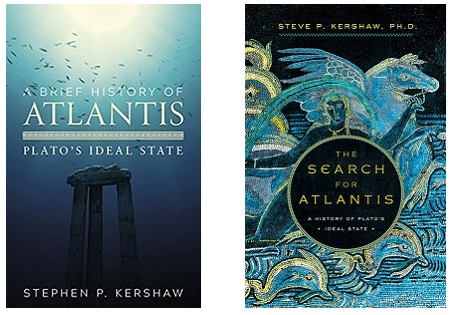
2018 edition under different title

In 2018, Kershaw’s book was reprinted by Pegasus Books for the US book market under a different title, without announcing that this is just the same book. Even on the copyright page this fact is not mentioned! The book itself is exactly the same, page by page, word by word, including bibliography and index. – Again, this book was not fair to its readers, who bought the same book twice under different titles. And it reminds of the repeated exercise of peudoscientific authors who edit their same books time and again under various titles.

Let us have a closer look at the few changes in title and blurb:

The author’s name:

  • UK: „Stephen P. Kershaw“
  • US: „Steve P. Kershaw, Ph.D.“

Obviously, the „Ph.D“ shall suggest academic competence, and „Steve“ sounds more American than „Stephen“?

The book’s title:

  • UK: „A brief history of Atlantis – Plato’s ideal state“
  • US: „The search for Atlantis – A history of Plato’s ideal state“

The US title inserts the aspect of „search“. Both versions contain the heavy mistake to suggest to the readers that Atlantis represented Plato’s ideal state.

The book’s blurb:

  • UK: The emphasis is completely on contemporary politics and „Trumpism“. First sentence of the blurb in style of a headline is: „Why today’s leaders should pay heed to Plato’s tales of an ideal state, and its ruin.“ Further: „contemporary relevance“, and: „post-truth world“, and: „should be prescribed reading for every political leader.“
  • US: The US blurb puts the emphasis on the aspect of the search, on open questions, and even omits completely that the basic idea of this book is that Atlantis is an invention and nothing more. In the jacket’s inside blurb, one sentence of the British version is repeated: „… should be prescribed reading for every political leader.“ And then the question follows, whether Atlantis is history or a parable, and this question is left open, as if the book left this question open.

Obviously, the US edition eliminated everything which could be understood as criticism of the Trump presidency, and wants to attract the supporters of the existence of Atlantis, by suggesting that the book is about search, about open questions, and by not giving any hint that this book proclaims a very clear and one-sided message: Atlantis is an invention, and Atlantis searchers are not very intelligent, or even evil.

Also the biographical text about the author has been shortened by ca. 50%, but no special observation, here.

Bibliography

  • Kershaw (2017): Stephen P. Kershaw, A Brief History of Atlantis – Plato’s Ideal State, Robinson, London 2017.
    Identical to:
  • Kershaw (2018): Steve P. Kershaw, The search for Atlantis – A history of Plato’s ideal state, Pegasus Books, New York 2018.

Bewertung: 1 von 5 Sternen.

(Erstveröffentlichung auf Atlantis-Scout November 2017)

Jürgen Roth: Der Deutschland-Clan – Das skrupellose Netzwerk aus Politikern, Top-Managern und Justiz (2007)

Interessant, aber dennoch völlig unbefriedigend

Irgendwie befriedigt dieses Buch nicht. Nicht, dass es nicht ordentlich recherchiert wäre. Manches ist auch interessant. Aber … zum einen schildert Roth viele einzelne Fälle, die jedoch keinen Zusammenhang haben; deshalb schon von einem „Clan“ zu sprechen halte ich für gewagt. Vieles hat man auch schon als aufmerksamer Zeitungsleser mitbekommen, Roth liefert da nur noch ein paar Zusatzdetails.

Aufgefallen ist mir, dass Roth Gewerkschaften, Verbände, NGOs, Kirchen, islamische Organisationen u.v.a. nicht zum „Clan“ zu rechnen scheint, sie kommen nicht vor. Etwas nervig ist, dass Roth offenbar politisch spürbar links steht: Notwendige Maßnahmen zum Umbau des Sozialstaates sieht er deshalb als Teil des „Clans“. Ebenso geht es mit notwendigen marktwirtschaftlichen Bereinigungsprozessen, die für die Betroffenen natürlich schmerzlich, für die Gesellschaft aber unumgänglich sind.

Völlig unbefriedigend ist, dass Roth immer nur Probleme darstellt, aber kaum eine Zeile darauf verwendet, was sich denn ändern müsste, damit die beschriebenen Probleme reduziert werden. Klagen ist immer einfacher als Vorschläge machen. Mich würde z.B. interessieren, welche Maßnahmen in Italien sich als wirksam gegen die Mafia herausgestellt haben.

Alles in allem entnehme ich dem Buch die wenig originelle These, dass die Moral der Gesellschaft insgesamt abgenommen hat. Dieses Phänomen, seine Ursachen, und was man dagegen tun könnte, hätte Roth viel intensiver beleuchten sollen.

Bewertung: 2 von 5 Sternen.

(Erstveröffentlichung auf Amazon am 05. April 2009; dort inzwischen nicht mehr aufzufinden)

Sonia Rossi: Fucking Berlin – Studentin und Teilzeit-Hure (2008)

Klischeehaft und ohne Berlin-Bezug

Das Buch „Fucking Berlin“ von Sonia Rossi ist leider nur ein typisches Milieu-Buch, das die üblichen Klischees ableiert. Die arme Studentin aus behütetem Hause, das schrittweise Abrutschen in die Prostitution, das den Übergang von moralisch zu unmoralisch kaschiert, der liebe, aber naive Freund, das völlig irrationale Verlieben in einen kiffenden Strichjungen, was einem Mädchen aus gutem Hause wohl eher selten passieren dürfte, die Abtreibung, das eigene Kind, die üblichen Freier-Archetypen usw. usf.

Dieses Buch könnte von vorne bis hinten eine einzige Erfindung nach Vorgabe sein. Aber vielleicht ist die Wirklichkeit in diesem Milieu ja tatsächlich eine Ansammlung von Klischees. Das Leben kann manchmal sehr banal sein. In diesem Sinne wäre es dann doch gut, dass dieses Buch geschrieben wurde.

Wie auch immer: Man sollte durchaus einmal ein Buch dieser Art gelesen haben, aber dieses eine Buch reicht dann fürs Leben. Mit Berlin hat die Story übrigens nicht allzu viel zu tun.

Bewertung: 3 von 5 Sternen.

Gelesen und rezensiert: Januar 2011.

Joachim Gauck: Winter im Sommer – Frühling im Herbst – Erinnerungen (2009)

Das Selbstverständliche sagen, auch wenn es ungelegen kommt

Joachim Gaucks Autobiographie ist solide, enthält aber auch keine Überraschungen. Vor allem im Schlussteil äußert Gauck einige Selbstverständlichkeiten, deren Besonderheit allein darin liegt, dass es heute leider nicht mehr selbstverständlich ist, dass diese Ansichten geäußert werden. Beispiele: Bei aller Kritik am „kapitalistischen“ System, vor allem von linker Seite – ohne Freiheit wird alles nur noch schlimmer, ohne Freiheit ist alles nichts. Und: Die Linken behindern die Aufarbeitung des DDR-Unrechts und messen mit zweierlei Maß, weil sie nicht in der Lage sind, sich mit ihrer eigenen Schuld zu befassen. Es tut gut, diese Selbstverständlichkeiten ausgesprochen zu sehen, und dass Gauck dies tut, ist zu würdigen.

Grenzwertig ist Gaucks Würdigung des Widerstandes von Kommunisten. Er macht nämlich nicht deutlich, ob er hier den Widerstand von Einzelnen würdigen möchte, die aus Naivität die Unmenschlichkeit ihrer eigenen kommunistischen Ideologie nicht verstanden haben – das wäre in Ordnung. Oder ob er hier die kommunistische Ideologie ganz oder teilweise mit würdigt – das wäre nicht in Ordnung.

Interessant ist Gaucks Verhältnis zum christlichen Glauben. Denn Gauck wurde nicht deshalb Pastor, weil er besonders gläubig gewesen wäre, sondern weil ihn die Suche nach einer Ausweichmöglichkeit vor dem Regime dorthin trieb. Völlig akzeptabel ist es, wenn er schreibt, dass der Glaube „neben“ dem kritischen Denken steht. Völlig unverständlich jedoch ist es, wenn er tiefgläubige osteuropäische Bauern als Vorbilder im Glauben nennt – denn deren Gläubigkeit und Ungeplagtheit von Zweifeln ist ja keiner besonderen Leistung geschuldet, sondern vielmehr einem Mangel: Einem Mangel an Fähigkeit zur Selbstreflexion. Überhaupt kann die christliche Ausformung von Gläubigkeit bei Gauck nur vor dem Hintergrund seines Lebens verstanden werden: Die Umstände legten es ihm eben nahe, in die allzu große Ungewissheit des christlichen Glaubens zu „springen“, und Gauck „sprang“. Vernünftig ist dieser „Sprung“ jedoch nicht. Gaucks Erklärungen zu diesem Punkt sind sehr verständlich und müssen hingenommen werden, sie sind aber nicht überzeugend.

Die von Gauck gewählten Schwerpunkte des Buches verwundern ein wenig. Werden hier nicht zu viele Fluchtgeschichten erzählt? Gab es denn nichts anderes im Alltag der DDR? Andererseits muss man davon ausgehen, dass Gauck diesen Schwerpunkt nicht ohne Bedacht gewählt hatte. Vielleicht war es ja tatsächlich so, dass den Menschen in der DDR die Fluchten und Ausreisen als Hauptereignisse im Vordergrund ihrer Wahrnehmung standen, und nicht ihr Alltagsleben.

Etwas problematisch ist die Chronologie: Die Kapitel sind teilweise chronologisch, teilweise aber auch unchronologisch thematisch gehalten, so dass Gauck z.B. zunächst plötzlich verheiratet ist, die Darlegung seiner Eheschließung jedoch erst weiter hinten im Buch erfolgt.

Bewertung: 4 von 5 Sternen.

(Geschrieben Anfang März 2012)

Akif Pirinçci: Deutschland von Sinnen – Der irre Kult um Frauen, Homosexuelle und Zuwanderer (2014)

Ehrliche und untermauerte „Rede an die deutsche Nation“

Akif Pirincci (wie immer sich dieser Name ausspricht) hat eine flammende Rede und einen aufrichtigen Appell an die Deutschen geschrieben, der sich durch Klarheit ebenso wie Einfachheit auszeichnet, mit der er die Wahrheit auf eine zutiefst menschliche Weise ausspricht: Pirincci pflegt einen bodenständigen Realismus, der sich ein X nicht für ein U vormachen lässt, der sich einen Blick für das bewahrt hat, was nicht verschwindet, wenn man aufhört daran zu glauben. Dabei wünscht Pirincci den Grünen Gutmenschen nicht einmal Strafe an den Hals, sie mögen einfach nur die Klappe halten und gehen. Und seine holzschnittartigen Thesen lassen explizit Raum für Andersartigkeit, nur dass Pirincci diese nicht für den Normalfall hält und das auch klar sagt.

Seine Sprache ist weniger eine Gossensprache, sondern vielmehr die Sprache, in der ein Mensch denkt, aber nicht spricht. Eine Sprache der deutlichen Worte, die aber nicht verletzend gemeint sind, sondern nur wahr.

Sehr gut hat Pirincci das Thema der Öffentlichen-Rechtlichen Medien aufgegriffen, das im Tugendterror-Buch von Sarrazin seltsamerweise unter den Tisch fiel. Beim Thema Islam schwächelt Pirincci ein wenig, denn die Möglichkeit eines aufgeklärten Islam analog zum heutigen Christentum blendet er komplett aus – kein großes Problem, da der aufgeklärte Islam noch im Embryo-Status ist. Seine Erlebnisse vor einem deutschen Gericht sind lesenswert. Seine Analyse der prekären Lage der deutschen Mittelschicht (das sind Du und Ich) rüttelt auf. Seine Einsichten in Wirkzusammenhänge der Wirklichkeit sind teilweise beeindruckend.

Dies ist kein dummes Buch. Was ich bei Sarrazin ebenfalls noch nicht gelesen hatte, ist der Umstand, dass die Zuwanderer überwiegend männlich sind, und deshalb das Geschlechterverhältnis in Deutschland auf der Kippe steht. Pirincci kritisiert meisterhaft die deutschen Journalisten und Intellektuellen: Sollten sie nicht hinter den Vorhang der Verhältnisse schauen, anstatt dabei zu helfen, den Vorhang über die Verhältnisse auszubreiten?

Pirinccis Vision ist kein negativer Reflex, sondern ein konstruktiver Appell: Deutsche Männer! Deutsche Frauen! Ihr seid etwas, seid Euch dessen bewusst! Es ist eine Rede an die deutsche Nation, wie in Zeiten des Vormärz. Es ist weniger ein Versuch, ausgefeilte Lösungen für alles anzubieten, als vielmehr ein Aufruf zum Perspektivwechsel! Unter diesem Gesichtspunkt sind dann auch alle Grobheiten und Einfachheiten verständlich und verlieren ihre Schärfe.

Bewertung: 4 von 5 Sternen.

(Erstveröffentlichung auf Amazon am 10. August 2014; inzwischen dort verschwunden)

Birk Meinhardt: Wie ich meine Zeitung verlor – Ein Jahrebuch (2020)

Teils Ossi-Wessi-Geschichte, teils Zeugnis der Zunahme der Verlogenheit

Birk Meinhardt ist ein waschechter Ossi und erklärt sich dankenswerterweise ausführlich und ehrlich dazu, was das im Guten wie im Schlechten bedeutet. Hier ist das Buch sehr stark. Als er nach dem Mauerfall in den Westen zur Süddeutschen Zeitung kommt, fühlt er sich im Paradies: Er kann alles schreiben was er will! Doch dann bemerkt er immer mehr Einschränkungen, und am Ende passen seine neu erwachte Freiheitsliebe und die Linie der Zeitung nicht mehr zusammen.

Teilweise ist das einfach eine Ossi-Wessi-Geschichte. Der Ossi denkt, im Westen ist das Paradies, und dann ist es doch nicht so. Die Süddeutsche Zeitung hat, wie viele Zeitungen, eine recht klare Linie. Es war schon immer klar, dass man dort nicht alles schreiben kann. Nur hat Birk Meinhardt dies eben erst spät bemerkt. Und es ist im Grundsatz auch nichts verkehrt daran, dass verschiedene Zeitungen verschiedene „Linien“ haben. Das Verlogene liegt eher darin, dass diese Blätter nicht offen dazu stehen und ihre Linie nicht im Untertitel ihrer Zeitung klar zum Ausdruck bringen.

Doch auf dieses Niveau bringt Birk Meinhardt seine Kritik nicht. Teilweise offenbart der Autor, dass er selbst eine recht einseitig Sicht auf die Welt hat. Er ist gegen die USA und ihre Kriege, gegen die NATO, für Russland, usw. usf. Das darf er sein, und es sollte auch eine Zeitung dafür in Deutschland geben, und sowas sollte auch im Öffentlich-Rechtlichen fair behandelt werden. Aber dass er damit bei der Süddeutschen nicht ankommt, ist klar.

Interessanter ist, dass dieses Buch teilweise auch ein Zeugnis dafür ist, dass die Verlogenheit und Einseitigkeit in Deutschland in den letzten Jahrzehnten tatsächlich zugenommen hat. Leider wird das aber nicht sauber von der Ossi-Fehlwahrnehmung getrennt. Der Leser muss sich selbst denken, was auf das eine Phänomen und was auf das andere Phänomen zurückgeht.

Das Buch ist dort stark, wo es ehrlich die eigene Geschichte und die Vorgänge in der Süddeutschen Zeitung beschreibt. Man sieht, was läuft, und wie es läuft. Das ist immer gut und der Anfang und die Basis jeder Kritik. Das Buch schafft es aber nicht, die Analyse auf ein höheres Niveau zu heben, das geeignet wäre, echte Lösung zu formulieren. Es bleibt sozusagen auf Wutbürger-Niveau hängen. Klar, die Zustände machen wütend. Aber die Lösung kann eben nicht sein, dass die Süddeutsche Sachen veröffentlicht, die ihrer Linie zuwiderlaufen. Deshalb nicht volle Punktzahl.

Die richtige Kritik wäre gewesen: Die Süddeutsche muss offen zu ihrer politischen Linie stehen. Und es muss andere Zeitungen und öffentlich-rechtliche Journalisten geben, die auch die anderen Meinungen zum Zuge kommen lassen.

Bewertung: 4 von 5 Sternen.

(Erstveröffentlichung auf Amazon am 14. Februar 2021)

Thomas A. Szlezák: Platon lesen (1993)

Allgemeinbildende Grundeinsichten zu Platons Dialogen

Die Dialoge Platons sind grundlegende Texte unserer Kultur der Aufklärung und können und sollten von jedem gelesen werden. Auf einer oberflächlichen Ebene sind sie auch leicht und unmittelbar zu verstehen.

Doch wer etwas tiefer in die Materie eindringen möchte und die Frage stellt, was Platon mit seinen Dialogen genau bezweckte und sagen wollte, der ist mit „Platon lesen“ von Szlezák zunächst ganz gut bedient. Was hier über Platon gesagt wird, gehört genauso zur grundlegenden Allgemeinbildung wie die Ergebnisse der historisch-kritischen Forschung über die Texte von Bibel, Koran u.a.

Natürlich ist nicht alles, was Szlezák sagt, unumstritten, so z. B. seine Auffassungen zur Verwendung des Begriffes „Mythos“ durch Platon. Dennoch: Leseempfehlung!

Bewertung: 5 von 5 Sternen.

(Erstveröffentlichung auf Amazon am 11. März 2011)

Frank Dörnenburg: Pyramidengeheimnisse? Enträtselte Mysterien (2008)

Endlich eine bilderreiche und kluge Aufklärung rund um Pyramiden

Was ist nicht alles schon über Pyramiden geschrieben worden, was hat sich nicht alles an Fragen angehäuft: Hypothesen, Vermutungen, Halbwissen, Pseudowissenschaft, Irrtümer, Kurzschlüsse, Gerüchte, Zahlenspiele – wer blickt da noch durch? Und wer könnte es wagen, aufgrund fundierter Kenntnisse eine Bresche durch diesen Dschungel zu schlagen und aufzuklären, an welcher Idee etwas dran ist – und an welcher nicht?

Es ist natürlich Frank Dörnenburg, der in der Szene durch seine Homepage bereits bestens bekannt und eingeführt ist. Geduldig und präzise schreitet er in seinem Buch von Kapitel zu Kapitel, von Thema zu Thema voran, und erklärt mit Engelsgeduld, warum diese oder jene Idee nicht funktionieren kann. Das Ganze ist mit einer Fülle von Bildern garniert, die die Meinungen von Dörnenburg aufs Beste belegen.

Keine Frage: Dieses Buch ist eine absolute Kaufempfehlung!

Bewertung: 5 von 5 Sternen.

(Erstveröffentlichung auf Amazon am 16. November 2008)

Martin Walser: Über Deutschland reden (1988)

Notwendige und unbequeme Gedanken zur deutschen Nation inmitten des anti-deutschen Selbsthasses

Das vorliegende Suhrkamp-Büchlein versammelt verschiedene Aufsätze und Reden von Martin Walser aus den Jahren 1979 bis 1988, die alle von Deutschland und der deutsche Kultur handeln. Damals, 1988, hatte eine linksdominierte Öffentlichkeit den Gedanken an Deutschland und die deutsche Nation in der BRD praktisch geächtet. Erst die Wiedervereinigung brachte dann – für viele höchst unerwünscht – den Gedanken an Deutschland wieder auf die Tagesordnung und führte zu einer teilweisen Normalisierung. Spätestens in den Merkel-Jahren wurde diese Normalisierung wieder zurückgefahren, so dass der Gedanke an Deutschland, die deutsche Nation und die deutsche Kultur heute (2026) ähnlich geächtet ist wie damals.

Die Sprache und die Gedankengänge Walsers sind teilweise „dicht“ im literarisch-philosophischen Sinn, d.h., der Text ist sind nicht immer ganz leicht zu verstehen und auf einen Nenner zu bringen. Wir wollen im folgenden die Kerngedanken und zentralen Zitate herausziehen, um dieses vergessene Büchlein für eine breitere Leserschaft fruchtbar werden zu lassen. Statt die einzelnen Aufsätze und Reden chronologisch durchzugehen, werden die einzelnen Aussagen nach Themen sortiert besprochen, also unabhängig davon, in welchem der Aufsätze und Reden zwischen 1979 und 1988 die Aussagen gemacht wurden.

Umgang mit dem Holocaust

Die zentrale Frage zur deutschen Nation ist natürlich der Umgang mit dem Holocaust. Sieht man den Holocaust als den Gipfelpunkt der deutschen Kultur und des deutschen (Un-)Wesens an, dann ist mit dem deutschen Wesen natürlich kein Blumentopf mehr zu gewinnen. Doch ist das wirklich so? Kann und darf man Deutschland und die Deutschen auf den Holocaust reduzieren?

Dazu hat Martin Walser im Jahr 1979 zwei Texte verfasst, die seltsam widersprüchlich sind. Zuerst den Aufsatz „Händedruck mit Gespenstern“, in dem er den linken Intellektuellen vorwirft, sie würden sich selbst von aller Schuld freisprechen und statt dessen die ganze Schuld beim Volk, dem deutschen Volk, abladen:

„Aber in der Rückschau auf das Jahr 1933 hat man sich nahezu festgelegt auf eine Meinung, in der das deutsche Volk als eine Masse erscheint, die zum Reaktionären, Kleinbürgerlichen, Dumpfen, Aufklärungsfeindlichen, Faschismusverdächtigen neigt. Die zurechnungsfähigen Intellektuellen waren an 1933 offenbar nicht beteiligt oder sie waren Opfer. Schuld war wieder dieses deutsche Volk, das dem Verbrechen zugeschaut hatte, mitgemacht hatte, gejubelt hatte. Wieder waren die zurechnungsfähigen Intellektuellen nicht dabei. Mit diesen fanatisierten Kleinbürgern hatten sie nichts zu tun. Und die Kapitalisten sind sowieso jedesmal auf der Seite der Kriegs- und Geschichtsgewinner. Der Dumme ist immer das Volk.“ (S. 19)

Hier nimmt Martin Walser die Deutschen also in Schutz vor einem kollektiven Schuldvorwurf, den ausgerechnet die linken Intellektuellen beim einfachen Volk abladen, während sie sich selbst eine weiße Weste attestieren. Hier sind wir beim Vorwurf des „Shitbürgertums“ von Ulf Poschardt aus dem Jahr 2025, demzufolge viele dieser linken Intellektuellen ganz und gar keine weiße Weste hatten, sondern selbst Sympathisanten der Nazis waren. Ihr pauschaler Vorwurf an „die Deutschen“ ist in diesem Sinne eine Strategie, der eigenen, persönlichen Schuld zu entkommen.

In seiner Rede „Auschwitz und kein Ende“ aus demselben Jahr 1979 spricht Walser jedoch ganz anders. Mit der Formulierung „wir, die wir zur Volksgemeinschaft der Täter gehören“ (S. 24) ist Walser ganz nahe an dem bösen Wort vom „Tätervolk“. Walser weiter: „Wir auf jeden Fall helfen uns eben dadurch, dass wir die Schuld … … … auf eine Handvoll Schergen schieben.“ (S. 24) – „Und doch ist diese Tötungsfabrik durch uns entstanden.“ – „In Auschwitz arbeitete unsere ganze Gesellschaft mit.“ (S. 25)

„Ein Franzose oder ein Amerikaner … muss nicht denken: Wir Menschen! Er kann denken: Diese Deutschen! Können wir denken: Diese Nazis!? Ich kann es nicht.“ (S. 25) Weiter: „Diese Schuld ist unter den Bedingungen unserer Geschichte entstanden. … Wir sind die Fortsetzung. Auch der Bedingungen, die zu Auschwitz führten.“ (S. 25 f.) „Kein Deutscher kann … sagen, seine Landsleute, die hier gewirkt haben, seien Psychopathen oder Spezialisten gewesen, mit denen habe er nichts zu tun.“ (S. 26 f.)

Walser diagnostiziert: „Uns fehlt etwas, was über den einzelnen hinausgeht. Etwas, dem er verpflichtet ist. Etwas, das ihn unfähig gemacht hätte, an der Auschwitz-Tötungs-Fabrik in irgendeiner Weise mitzuarbeiten. Etwas, was Gott und Humanismus noch nicht schafften.“ Walser weiter: „… kann nicht gedient sein, wenn ein Verbrechen solchen Ausmaßes nachträglich herunterdividiert wird auf ein paar Bösewichter. Was ist das für eine Einteilung: Ich gehöre dazu, sobald es sich um Goethes Faust handelt, aber mit dem Dr. Faust in Auschwitz habe ich nichts gemein. Wir haben mit ihm alles gemein, was wir mit Goethe gemein haben.“ (S. 29) Und: „Ich glaube: man ist Verbrecher, wenn die Gesellschaft, zu der man gehört, Verbrechen begeht.“ (S. 30)

Mit diesen Worten ist Martin Walser wieder ganz und gar bei der Kollektivschuldthese angelangt: Alle Deutschen sind schuldig, allein, weil sie Deutsche sind. Den Deutschen fehle etwas, was andere Völker angeblich hätten. Begründet wird dies mit schrägen Thesen: Denn Goethes Faust, den Walser anführt, ist ein höchst öffentliches Werk, das die deutsche Nation wahrlich geprägt hat, während Walsers „Dr. Faust in Auschwitz“ bekanntlich höchst unöffentlich zu Werke ging, und das aus gutem Grund: Weil die Deutschen dieses Verbrechen nämlich keinesfalls gutgeheißen hätten, hätte man es öffentlich gemacht.

Natürlich ist der erste Ansatz von Martin Walser wesentlich zielführender als der zweite: Es gibt keine Kollektivschuld, natürlich nicht, denn der Gedanke einer Kollektivschuld widerspricht jedem humanistischen Geist. Gewiss, die Zahl der Schuldigen ist hoch. Es sind nicht nur ein paar wenige Anführer schuldig geworden, das ist schon richtig. Aber es ist eben auch nicht so, dass das ganze deutsche Volk wie ein Mann diesem Verbrechen zugestimmt hat. Ganz und gar nicht. Es ist etwas zwischen diesen beiden Extremen, auf jeden Fall eine höchst ungleiche Verteilung von Schuld, und es ist bis heute nicht hinreichend erforscht worden, wie diese Schuld eigentlich tatsächlich verteilt ist. Ein Grund dafür ist, dass mit dieser Frage Politik gemacht wird. Bis heute. Das ist ja das Problem.

Wie kommt es, dass Martin Walser in zwei Texten desselben Jahres 1979 einmal so und einmal so sprach? Man kann nur Vermutungen anstellen. Vielleicht ist der Grund, dass der zweite Text eine Rede zu einer Ausstellung ist, wo Walser auch vor Opfern des Holocaust sprach. Vielleicht empfand Walser es in dieser Situation passender, nicht zu differenzieren? Ehrlich wäre er dann nicht gewesen. Seine ehrliche Meinung finden wir ganz offensichtlich im ersten Text. Und in seinen weiteren Texten, in denen er die deutsche Kultur vor jedem Pauschalvorwurf in Schutz nimmt, wie wir im folgenden sehen werden.

Die Anti-Deutschen als Folge des Holocaust und 1918

Martin Walser sieht genau, wie der anti-deutsche Reflex der BRD aus einem Versagen des Umgangs mit Auschwitz erwächst: „Aber ich muss zugeben, eine rein weltliche, eine liberale, eine vom Religiösen, eine überhaupt von allem Ich-Überschreitenden fliehende Gesellschaft kann Auschwitz nur verdrängen. Wo das Ich das Höchste ist, kann man Schuld nur verdrängen.“ (S. 20)

Auch die Auflösung von nationaler Identität im Individualismus ist eine Flucht vor der Verantwortung: „Deutsches Volk? Nie gehört.“ (S. 28) „Ich weiß ja, wie wenig ernst der BRD-Erfolgsmensch seinen Pass nimmt. Er ist mindestens Europäer.“ (S. 93) „Wo Miteinander, Solidarität und Nation aufscheinen, da sieht das bundesrepublikanisch-liberale Weltkind Kirche oder Kommunismus oder Faschismus.“ (S. 20) Auch die Wirtschaft zieht sich aus der Affäre: „Ja, Firmen waren auch dabei in Auschwitz. Aber was ist eine Firma? Hat eine Firma Gedächtnis? Gewissen?“ (S. 28) „Internationalismus ist in Ost- und Westdeutschland ein gleichermaßen forcierter Wert.“ (S. 22)

Nur im Ausland sei man zwangsläufig Deutscher: „Es soll in den letzten dreißig Jahren öfter vorgekommen sein, dass Deutsche im Ausland durch entgegenkommend gemeintes, betont undeutsches Auftreten besonders unangenehm deutsch gewirkt haben.“ (S. 94)

Heutige Historiker sagen mit ihren Analysen des Nationalsozialismus mehr über die Gegenwart als über die Vergangenheit (S. 78). Ein Gespräch über Deutschland ende immer ungut, auch unter Freunden (S. 79). Alles sei von Phrasen überdeckt: „Deutschland habe es sowieso nie gegeben.“ – „Also nie mehr Deutschland.“ (S. 80) – Dabei war Deutschland und seine Einheit im 19. Jahrhundert demokratisch gedacht worden, selbst Karl Marx sprach von Deutschland (S. 81).

Heute heiße es: „Die Deutschen sind alle Nazis“ (S. 85) Walser wundert sich: „wie viele bedeutende Leute Jahrzehnte nach der Erledigung des Faschismus ihren Zorn und ihr gutes Gewissen lebenslänglich durch antifaschistische Regungen belebten.“ (S. 86) Dem Historikerstreit, der von Habermas losgetreten wurde, ist Walser dankbar: Denn er hat zu einer Vielfalt von Ansichten von Links und Rechts geführt, die Walser problemlos in seiner Person integrieren kann, so behauptet er (S. 86 f.).

Willy Brandt nenne die deutsche Frage jetzt „Schizophrenie“, Egon Bahr empfiehlt „Verfassungspatriotismus“, und Otto Schily will die Verpflichtung zur Wiedervereinigung aus der Präambel des Grundgesetzes streichen lassen. (S. 90) „Politik, Schule und Medien, die Wortführer also, haben, mit krass verschiedenen Motiven, viel getan, um die Teilung vernünftig zu machen.“ (S. 92) Wer davon sprechen möchte, dass es noch Deutsche gibt, muss es beweisen, als ob es eine außergewöhnlich kühne Behauptung wäre: „Das muss man beweisen, weil einem im Deutschland-Gespräch auch Karthago und die Azteken vorgehalten werden.“ (S. 93)

Martin Walser setzt den Beginn der Probleme mit der Nation sogar schon 1918 an: „Ich vermute, dass unsere nationale und gesellschaftliche Ratlosigkeit eine Folge unserer Entfernung von unsere Geschichte ist. Mir kommt es so vor, als hätten sich unsere Intellektuellen nach 1918 vom Volk getrennt … … … Schon das Wort ruft vielfältiges Schaudern hervor. Volk – ist das überhaupt ein Begriff? Ist das nicht ein total obsoletes Wort?“ (S. 17 f.)

Das Volk hatte die Folgen des Ersten Weltkrieges zu erleiden, die „bürgerlich-feudalen Cliquen“ nicht. Schon in den 1920er Jahren waren Philosophie und Literatur internationalistisch geprägt. „Die Intellektuellen hatten Roaring Twenties. Arbeiter und Kleinbürger hatten einen aussichtslosen Kampf gegen immer neue Einfälle eines nun doch wirklich international auftretenden Kapitalismus.“ (S. 18)

Am Ende sei immer das Volk der Dumme. „Das [Volk] lernt eine Lektion nach der anderen und kommt kaum nach mit Lernen und Umlernen. Und das deutsche Volk ist ein Musterschüler. In Ost und West. Lieber verliert es sich selbst, als dass es seinem Ost- oder Westlehrer auch nur den geringsten Kummer bereiten würde. Wir haben immer alles besser gekonnt, als wir selbst zu sein.“ (S. 19)

Die BRD ist geschichtslos geworden. „Geschichtsabweisend ist der aktuelle Intellektuelle.“ (S. 20) „Adorno hat diese Geschichtsverneinung mit polemischen Bemerkungen gegen Brecht blanko abgesegnet.“ (S. 20 f.) Der deutsche Kulturbetrieb kennt keinen Sinn mehr im Leben, Sinn wird produziert wie Weizen und Milch (S. 21). Es gilt: „Praxis adieu. Volk adieu. Ich gestatte mir, dazuzusetzen: Gott adieu. Weil Gott für mich kein obsoletes, sondern ein historisches Wort ist für das Bedürfnis nach Ichüberschreitung. Ich halte auch die Zielrichtung nicht für obsolet. Dass uns etwas fehlt, sieht jeder.“ (S. 22)

Deutschland vor den Anti-Deutschen retten

Martin Walser will sich mit diesem Zustand nicht abfinden. „Wer sind wir? Sobald man im Ausland ist, ist man ein Deutscher. Aber wer bin ich hier?“ (S. 19) – „Ich habe ein Bedürfnis nach geschichtlicher Überwindung des Zustands Bundesrepublik. Von Grund auf sollten wir weiter. Aber die herrschende öffentliche Meinung, das herrschende Denken, der vorherrschende Sprachgebrauch nennen dieses Bedürfnis obsolet, obsolet heißt veraltet; ich glaube nur, es sei alt.“ (S. 23)

Eine ewige Strafe für den Holocaust will Walser nicht anerkennen: „Dass ich Jalta, Teheran und die Folgen Strafaktion nenne, ruft Stirnrunzeln hervor. Ich beeile mich zu sagen, dass wir die verdient hatten. Aber doch nicht für immer. Strafe dient nicht der Sühne, sondern doch wohl der Resozialisierung.“ (S. 83) Es sei ungerecht, Schlesierschmerz in einem Atemzug mit Neonazitum nennen (S. 83). „Wir nicken zu allem vor lauter Angst, sonst für Nazis gehalten zu werden.“ (S. 84)

Eine Quelle der Regeneration Deutschlands sieht Walser in der Geschichte: „Seit die konvulsivische Nation nun zerstört ist in einem Ausmaß, das eine Nation allein überhaupt nicht verschulden kann, ist sie mehr als andere auf Geschichte verwiesen. Nur wenn wir eine Nation waren, werden wir wieder eine sein. Und das regelt keiner außer uns selbst.“ (S. 32) – „Von Gewissheit umstellt, widersprechen wir. Es gibt keine mit der Schwäche vergleichbare Kraftquelle.“ Und: „Aus diesem Aber bauen wir den unterirdischen Himmel, den der Geschichte.“ Schließlich: „Der Unterirdische Himmel ist, wenn er sich treu bleibt, subversiv.“ (S. 38)

Walser verweist auch auf jene wenigen Intellektuellen, die mit ihm seine Bedenken teilen und ihrerseits an Deutschland nicht irre geworden sind: Hans Magnus Enzensberger und Uwe Johnson (S. 91 f.).

Schließlich meint Martin Walser, das die Deutschen in der DDR oft authentischer Deutsche geblieben seien als die Westdeutschen. Der Brief einer Dresdnerin, wie froh sie ist, von ihm nicht vergessen worden zu sein, ist dafür ein Beleg. Oder die Gedichte von Wulf Kirsten aus Weimar. Diese leben aus einem Sinn für Geschichte und belegen: Es gibt noch „unblamiertes Deutsches“ (S. 98). „Wirkt, verglichen mit einem Kirsten, viel Westliteratur nicht wie Ideologie?“ (S. 96)

„Die Nation ist im Menschenmaß das mächtigste geschichtliche Vorkommen, bis jetzt. Mächtig im geologischen, nicht im politischen Sinn. Die Nation wird sich sicher auflösen irgendwann. Aber doch nicht durch eine Teilung. Doch nicht durch Jalta-Churchill-Roosevelt-Stalin.“ (S. 99) – Im Jahr 1988, nur ein Jahr vor 1989, schrieb Walser: „Es gibt demnach nicht die geringste konkrete Aussicht auf einen Anfang der Überwindung der Teilung. Deutschland bleibt demnach ein Wort, brauchbar für den Wetterbericht. Ich wundere mich selber darüber, dass diese konkrete Aussichtslosigkeit bei mir nicht umschlägt in Hoffnungslosigkeit. Vielleicht wirkt da dieses Geschichtsgefühl.“ (S. 100)

Demokratie und Medien

Martin Walser stellt der Demokratie der BRD und ihrem Mediensystem kein gutes Zeugnis aus. Er sieht eine wachsende Diskrepanz zwischen dem, was geschrieben und dem was verschwiegen wird. Die Differenz ist der „innere Samisdat“. (S. 10 f.) „Pluralismus als Fleckerlaufbahrung, das ist unser Ideal. Möglichst viele Farben, möglichst folgenlos, möglichst öffentlich: so unser Presse-Credo. Demokratische Entwicklung gediehe, glaube ich, nur dann, wenn wirkliche Widersprüche wirklich öffentlich werden könnten.“ (S. 11) Statt dessen: „eine aus lauter monochromen Partien bestehende öffentliche Meinung täuscht Vielfalt vor, wie die östliche veröffentlichte Meinung Öffentlichkeit vortäuscht.“ (S. 11)

„Unser Pluralismus hat so viel Wirklichkeit wie ein in einem Disney-Atelier gezeichneter Dschungel Natur: in solchen Ateliers gibt es ja auch Spezialisten für Tigertatzen, Samtpfoten, Wolken und Veilchen; aber alles ist eben just animated.“ (S. 12) Walser wendet sich gegen den Kleingeist der „Fachleute“, denn in Wahrheit komme es auf den politischen Willen der Akteure an: „Es ist immer mehr möglich, als Fachleute auszurechnen imstande sind“ (S. 90).

Der Grundgedanke der Demokratie wird nicht verwirklicht: „Und die Leute werden nicht gefragt. Das Volk! Populist wird man geschimpft, wenn man meint, die Deuschland-Frage könne nur vom Volk beantwortet werden.“ – „Wir leben noch in einer Zeit, in der nur von oben nach unten gesprochen wird. Von unten nach oben gibt es die Volksstimme nur demoskopisch verfremdet.“ – „Also liegt alles an den Regierungen. Und damit im argen. Es sei denn, die beiden Bevölkerungen ließen sich diesen Pragmatismus nicht ewig gefallen.“ (S. 100)

Walser weist auf die Bedeutung von Öffentlichkeit für die Demokratie hin: „Zweifellos war die öffentliche Meinung das bürgerliche Befreiungsinstrument schlechthin.“ – „Die öffentliche Meinung ist also so ehrwürdig wie die Verfassung.“ (S. 55) – Doch mit dem Mainzer Revolutionär Georg Forster fürchtet Walser deutsche Zustände: „In Deutschland … wird also nicht das Bürgerrecht aus der öffentlichen Meinung stammen, sondern man wird irgendwie ein Bürgerrecht heraufzaubern, und dann öffentliche Meinung damit machen, von oben nach unten also.“ (S. 56) Walser weiter: „Wenn die öffentliche Meinung in den Händen derer ist, die durch sie kontrolliert werden sollen, dann ist – um im Bilde zu bleiben – das Nervensystem unter Vollnarkose.“ (S. 57)

Walser wendet sich gegen Medienmogule wie Berlusconi (S. 53) oder gegen beherrschende Medienkonzerne wie z.B. Bertelsmann, ohne sie beim Namen zu nennen: „Finstere Verlagsschranzen und Medienmonster mit ihrer die Seelen ganzer Kontinente beugenden Macht machen die ältesten Drachensagen zum aktuellen Bilderbuch.“ (S. 39) Das damals neue Privatfernsehen (Bertelsmann, Leo Kirch) ist für Walser keine kommerzielle Veranstaltung, sondern Ausübung von Macht (S. 63).

Das öffentlich-rechtliche Mediensystem hält er für konkurrenzfähig, man müsse nicht darauf bestehen, dass es keine Privaten geben solle. Auf jeden Fall sei wichtig, „dass wir nicht an der Etablierung von Macht, sondern an der Schaffung einer Gegenmacht interessiert sind“ (S. 61).

Denn Macht sei per se ein Problem. „In dreißig Jahren Ausdrucksgewerbe habe ich keine Erfahrung gemacht, die deformierender, verheerender, krankmachender gewesen wäre, als die Erfahrung der Ohnmacht.“ (S. 62) – „Dass Macht nur missbrauchbar ist, wurde im Laufe der Jahre meine wichtigste Erfahrung. Ich habe noch keinen einzigen Menschen getroffen, der durch Machtbesitz nicht entstellt worden wäre.“ (S. 62 f.) – „Macht ist in dem Maße schlimm, wie sie unkontrollierbar ist, egal wer sie ausübt.“ (S. 63)

Sprache und Literatur

Martin Walser kritisiert die Kritik der Frankfurter Schule am sogenannten „Jargon der Eigentlichkeit“: „Schlimmer als der geschmähte Jargon der Eigentlichkeit kommt mir der Jargon vor, in dem da geschmäht wurde.“ (S. 17) – Denn: „Die Sprache sagt nur etwas, wenn sie von Unschuldigen benutzt wird.“ (S. 17) – „Das richtige Verhalten ist wahrscheinlich nur mit dem historischen Vermögen der Sprache zu erörtern.“ (S. 17)

Walser wendet sich gegen die traditionelle Definition von Klassikern in der Literatur. Bei traditionellen Klassikern ginge es oft um die Legitimierung von Macht. Denn was ein Klassiker sei, definiere sich durch dessen Brauchbarkeit. Was ein Klassiker ist, entstehe so durch das Volk und dessen Benutzung von Literatur. (S. 42 f.)

Wer Selbstbewusstsein nötig hat, wird bei Goethe fündig. Wer die Bürgerliche Freiheit und das Schöne entdecken will, greift zu Schiller. Wer verzweifelt, weil es in Deutschland nicht besser werden will, sucht bei Jean Paul Trost. Fichte und Kant sind ihrerseits widerständig gegen die Verhältnisse. Und eiNne Jugend, die reine Helden braucht, findet sie bei Karl May. (S. 43 f.)

„Der Klassiker ist zuerst ein Klassiker seiner Nation.“ (S. 44) – „Unser Klassiker bringt unsere Geschichte zum Ausdruck. Also können wir ihn brauchen.“ (S. 46) – „Sprache sammelt und vermehrt in jedem Klassiker ihr Vermögen.“ (S. 48) – Ohne Hölderlin, Goethe oder Schiller sei die deutsche Sprache gar nicht mehr denkbar.

Mit Goethe sagt Walser: „Übrigens ist mir alles verhasst, was mich bloß belehrt, ohne meine Tätigkeit zu vermehren oder unmittelbar zu beleben.“ (S. 52) So sollte ein echter Klassiker sein.

Walsers Selbstverständnis als Linker

Aus der Sicht des Jahres 2026 wirkt manches von dem, was Martin Walser damals schrieb, wie „rechts“. Aber natürlich verstand sich Walser als ein Linker, und das kommt auch wiederholt zum Ausdruck.

Ein Demokrat mit Anspruch auf die Verwirklichung der Demokratie wird von Walser kurzerhand als „Sozialist“ angesprochen. Und so verstand er sich selbst, wenn er auch anfügt: „Wie schonend, das nicht in der ersten Person sagen zu müssen.“ (S. 9)

Von der DDR hoffte Walser, dass sie sich zu einem echten Sozialismus entwickeln könnte: „es gibt aber auch die Hoffnung, dass aus dem real existierenden Sozialismus ein wirklicher werden könnte. … … … Die Schwierigkeit entsteht aber dadurch, dass wir dem Osten eine Entwicklungsmöglichkeit zugestehen müssen; auch um unseretwillen. Wenn wir ihn aber nur als etwas behandeln, was abgeschafft werden muss, dann haben wir diese deutsche Aufgabe verfehlt.“ (S. 58 f.) – Walser war auch der Auffassung, dass die Zustände in der DDR im Westen schwarzgemalt würden: „Das Kerkerbild, das hier von der DDR gemalt wird, soll unsere Leute dazu überreden, sich trotz ihrer Ohnmacht und Gezwungenheit frei zu fühlen.“ (S. 15) Statt das westliche System eindeutig als das bessere System zu bezeichnen, hält sich Walser auf Äquidistanz. Das ist sträflich.

Ein Satz stößt angesichts der kommenden Kriege im ehemaligen Jugoslawien und um die Ukraine als böser Irrtum auf: „Und Kriege finden in Europa sowieso nicht mehr statt.“ (S. 81)

Bezüglich der deutschen Geschichte ist Martin Walser ebenfalls auf linke Weise wählerisch. „Was 1871 gegründet wurde, war ja nicht das, was 1848 gewollt worden war.“ (S. 81) – „Nur wenn die Gefahr bestünde, dass wir ins Hohenzollern- oder Hitler-Deutsche zurückfielen, wäre die Teilung gerechtfertigt, ja geradezu notwendig.“ (S. 85) – Schließlich spricht Walser vom „konservativen Missbrauch“ und dem „Adenauerschen Wiedervereinigungsgedöns.“ (S. 90)

Es ist völlig geschichtsvergessen, das Kaiserreich und Nazi-Deutschland in einem Atemzug zu nennen. Wer das Kaiserreich so scharf ablehnt, wie es hier geschieht, der muss sich ernsthaft fragen lassen, wo er noch den Unterschied zu Hitler-Deutschland sieht, und wo er überhaupt ein gutes Deutschland sieht: Vielleicht in der Metternich-Ära? Oder im Dreißigjährigen Krieg?! Wer das Kaiserreich nicht als gelebte Normalität (mit Fehlern) begreifen kann, der sucht wohl nach Utopia. Das Kaiserreich von 1871 so wie Hitlerdeutschland verteufeln und ausgrenzen zu wollen, ist maßlos und falsch. Ebenso die Unterstellung, Konservative würden „Missbrauch“ betreiben, wenn sie von Wiedervereinigung sprechen. Wie demokratisch ist jemand, der Konservative wie Adenauer auf diese Weise aus dem demokratischen Spektrum ausgrenzt?

Nebenthemen

Ein Aufsatz von 1987 widmet sich dem Gegensatz von charaktervollen und charakterlosen Menschen. Der charakterlose Mensch vermeidet klare Urteile. Frauen tun das auch. Dem charakterlosen Menschen entspricht eine gegenstandslose Sprache, in der ein Urteil gar nicht mehr möglich ist.

An dem FAZ-Literaturkritiker Marcel Reich-Ranicki arbeitet sich Martin Walser an zwei Stellen ab. Einmal geht es um Literaturkritiker im Allgemeinen: Sie seien ihr eigener Maßstab. Manche hätten „Medienomnipräsenz“. Und dann fällt der Satz: „Am Kritiker erlebt man, wie Macht den Charakter düngt.“ (S. 69) Marcel Reich-Ranicki bleibt ungenannt, ist aber offensichtlich gemeint.

An einer anderen Stelle wird Marcel Reich-Ranicki explizit genannt und kritisiert, weil er Respekt für die Meinung von Franz Xaver Kroetz äußerte, es sei weise, dass es zwei Deutschlands gebe. Damit würde sich Kroetz der „hierzulande jetzt üblichen nationalen, mitunter ins Nationalistische übergehenden Heuchelei“ widersetzen, so Reich-Ranicki. (S. 87) – Walser wendet sich gegen den an ihn gerichteten Vorwurf von Marcel Reich-Ranicki, er sei Bonner Losungen verfallen und opportunistisch (S. 88). – Walser trocken: „Auch ein prominenter FAZ-Redakteur kann nicht alles, ja er darf nicht alles wissen. Je weniger einer weiß, umso infallibler ist er. Und am infallibelsten ist der Papst.“ (S. 89)

Auch Thomas Mann wird von Martin Walser wiederholt kritisiert. Zuerst habe Thomas Mann Goethe dazu missbraucht, um seine antidemokratische Haltung in den „Betrachtungen eines Unpolitischen“ zu legitimieren. Doch auch noch 1932 habe Thomas Mann Goethe dazu missbraucht, um sich nunmehr zwar nicht mehr als antidemokratisch, doch immer noch als unpolitisch zu stilisieren. Goethe und Schiller werden bei Thomas Mann zu Chiffren für Thomas und Heinrich Mann. (S. 49 f.; S. 67)

Bewertung: 4 von 5 Sternen.

« Ältere Beiträge