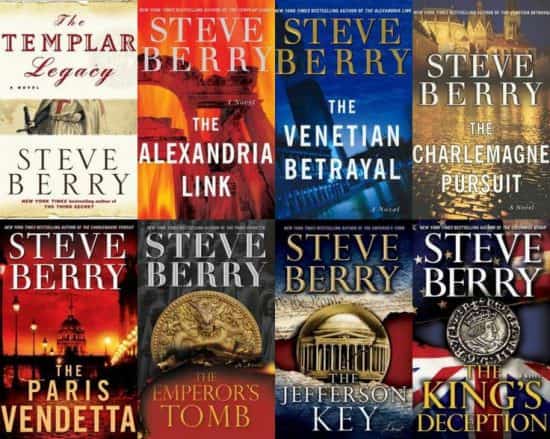
Overall Rating: 3 of 5 Stars.
Vol. 01: The Templar Legacy (2006) – Grundsolide mit Längen
Eine grundsolide geschriebene Schatzjäger-Story rund um die Geheimnisse von Rennes-le-Chateau, die allerdings ihre Längen hat: Sowohl werden die Charaktere in viel zu vielen und zu langen Rückblenden erklärt, als auch das Geheimnis von Rennes-le-Chateau besser und zu oft wiederholt erläutert, als es dem Leser lieb sein kann. Negative Überraschungen gibt es nicht, da grundsolide gemacht, aber dafür gibt es auch wenig positive Überraschungen. Im Anhang eine gute und genaue Beschreibung, was zum allgemeinen „Geheimnis“ rund um Rennes-le-Chateau gehört und was der Autor hinzu erfunden hat. Vielleicht werden sich spätere Bände der Serie steigern? Wer das Genre mag, wird jedenfalls gut bedient, man macht mit diesem Buch nichts falsch. Das englische Hörbuch ist gut gelesen von Paul Michael.
Rating: 4 of 5 Stars.
(First publication on Amazon 04 August 2012)
Vol. 02: The Alexandria Link (2007) – Wohlkonstruierte Wer-jagt-Wen-Story
Steve Berry hat mit dem Alexandria Link einen soliden und mehr als einmal sogar überraschenden Pageturner geschrieben. Zum einen werden die Handlungsfäden und die gegenseitigen Beeinflussungen der Personen so geschickt verflochten, dass die Story immer wieder eine überraschende Wendung nimmt. Zum anderen gelingt es Steve Berry, dem Leser eine Idee davon zu geben, wie die Überlieferungen von Bibel und anderen heiligen Schriften verfälscht worden sein könnten. Der stärkste Moment ist hier die Präsentation eines fiktiven Briefwechsels zwischen Augustinus und Hieronymus.
Damit sind wir auch beim Schwachpunkt: Die in diesem Buch behandelte Verfälschung des Bibeltextes ist ziemlich unhistorisch und wird nur von wenigen arabisch-freundlichen Wissenschaftlern geteilt. Es wäre besser gewesen, das Buch auf eine andere, inzwischen weithin akzeptierte Erfindung aufzubauen. Siehe dazu z.B. das Buch von Finkelstein und Silberman: „Keine Posaunen vor Jericho“. Der zweite Schwachpunkt ist, dass Israel ziemlich schlecht wegkommt gegenüber den Arabern. Der Autor kann zwar in dem angehängten Interview glaubwürdig versichern, dass er sich um Ausgleich bemüht hat, dennoch werden die guten Argumente Israels einem fiesen israelischen Agenten in den Mund gelegt, was kaum einen Leser zu Sympathie bringen dürfte. Für diese zwei Schwachpunkte 1 Stern Abzug.
Rating: 4 of 5 Stars.
(First publication on Amazon 04 August 2012)
Vol. 03: The Venetian Betrayal (2007) – Fairly good Steve Berry
A fairly good Steve Berry / Cotton-Malone novel. The historical background is interesting (the location of Alexander the Great’s tomb) and the proposed solution is elegant and realistic. The idea of a middle Asian federation is also interesting and realistic. The topic of biological warfare and HIV is handled well in this novel. Nice especially the running gag with the Greek Fire machines. The new character Victor can appear again in following books. Well-done part of the series.
Rating: 4 of 5 Stars.
(First publication on Amazon 18 September 2012)
Vol. 04: The Charlemagne Pursuit (2008) – Nice part of the Cotton Malone series
This part of the Cotton Malone series is considered to be one of the best, and rightly so: The plot is constructed well: Two sisters fighting against each other, two teams of investigators, one big bad influential guy with a crazy perfect killer and a female ally, one thrilling historical quest, and it’s all about the past death of Cotton Malone’s father in a sunken submarine and the purpose of his mission. What is less thrilling is that US President Dany Daniels is interfering too often, in reality this would not happen.
The historical background this time is not, as the title suggests, the early Middle Ages, but something totally different: The idea of a long-forgotten culture before all known cultures, from which all later cultures all over the globe allegedly got their initial kick-off: A developed town under the ice shield of Antarctica, called „Tartarus“. Unfortunately, such an early culture did never exist, and the plot of the book is thus partly unreasonable and supports pseudo-science. By the way: It is not meant to be „Atlantis“ which is explicitly considered to be a romantic reminiscence to the allegedly original „Tartarus“.
The author included the weird ideas of Germany’s National Socialists in the 1930s and 1940s who started expeditions in search for the roots of a „master race“. This historical aspect is even more interesting than this novel’s phantasy of an early Antarctic civilization. An epilogue makes clear what is fiction and what is fact.
Rating: 4 of 5 Stars.
Vol. 05: The Paris Vendetta (2009) – The wrath of Thorwaldsen creates a catastrophic fate
This time Steve Berry concentrates on Henryk Thorwaldsen and his revenge for the death of his son. Thorwaldsen found out who was the killer, but the Magellan Billet wants him, too, and alive. Cotton Malone stands between them and has to act as a friend against Thorwaldsen which escalates Thorwaldsen’s wrath to the extreme, with catastrophic consequences.
I enjoyed this book more than „The Charlemagne Pursuit“, it is much more realistic and the plot is really dramatic in the very sense. One important person has to die, another one comes newly into the story. The fight against the professional terrorist Peter Lion has James Bond qualities. One of the best Cotton Malone books, I would say.
What is strange is the notion that Muslims in France were allegedly repressed from taking part in the societal life and therefore tend to terrorism; no such repression exists, especially not in a laical country like France, rather it is the other way round that a certain part of the Muslims keeps distance to western rationality, freedom and the French way of life, although they are invited to take part; furthermore radical believers of all religions need no other reason for bombing than that someone is not submissive to their faith. All in all the book has a far too simple view on problems with Muslim immigration in Europe.
Rating: 5 of 5 Stars.
(First publication on Amazon 02 December 2012)
Prequel to Vol. 06: The Balkan Escape (2010)
Keine Rezension vorhanden.
Vol. 06: The Emperor’s Tomb (2010) – Exciting and informative episode of the Cotton Malone series
The usual concept of the Cotton Malone series plays out at its best in this part. This time it is again Victor who has to act in a difficult role, changing sides again and again. But what is important in addition to the exciting story is the information on China, present and past. The still not excavated emperor’s tomb, the role of Eunuchs, the eternal debate of legalists and Confucianists, etc., gives the reader much to learn and to think about.
Rating: 5 of 5 Stars.
Vol. 07: The Jefferson Key (2011) – Not the best part of the series
This part of the Cotton Malone series did not convince: The mystery is not an ancient mystery but an alleged secret from the beginning of the US history. Furthermore, this secret seems to be a bit far-fetched: Letters of marque, lost but still valid, pirates still active, hm? Ok, not each part of the series can be perfect. The person in focus this time is Dany Daniels, the fictitious president of the United States – or is he? More his wife, I would say, or … her friend. Well, well, hm. And the British fort where the climax of the story happens, where the secret is found and the final battle is taking place: It is invented, only. It does not sum up to a round story. You can better, Steve Berry!
Rating: 3 of 5 Stars.
(First publication on Amazon 21 July 2013)
Vol. 08: The King’s Deception (2013)
Keine Rezension vorhanden.
Vol. 09: The Lincoln Myth (2014) – Convincing part of the series
This time the main themes are the Latter Day Saints, Abraham Lincoln and the question of the legitimacy of secession of a state from the United States.
From Denmark over Salzburg/Austria to Demoins/Iowa and Salt Lake City/Utah the hunt for old and hidden documents and riddles goes through the constitutional history of the United States, and it is rewarding: We learn a lot of what happened and who decided which question, etc.
Very particular is the confrontation of Cotton Malone with Cassiopeia Vitt when he disturbs her while having a kind of rendezvous with an old resp. new lover in Salzburg, great : – )
The end is sad, but creates interest for more.
Rating: 5 of 5 Stars.
(First publication on Amazon 20 July 2014)
Vol. 10: The Patriot Threat (2015)
Keine Rezension vorhanden.
Vol. 11: The 14th Colony (2016)
Keine Rezension vorhanden.
Vol. 12: The Lost Order (2017) – Not convincing part of the series
This time it is about the Smithsonian Institution in Washington DC, the Knights of the Golden Circle, the Civil War, another ancestor of Cotton Malone, and an alleged gap in the US constitution. The whole thing is rather constructed, not very nice, and tension is created over too long periods for unnecessary reasons until it is resolved, and it is always clear how the tension will be resolved.
Rating: 3 of 5 Stars.
(First publication on Amazon 07 January 2020)
Vol. 13: The Bishop’s Pawn (2018) – Special episode: Martin Luther King Jr and Cotton Malone’s beginnings
This part of the Cotton Malone series shows Cotton Malone on his very first assignment for the Magellan Billet. Without preparation he is tossed into a dangerous treasure hunt with one murder after the other. Also he himself has to kill several times. At the beginning, it is the usual Cotton Malone novel: There is the treasure hunt, there are Cotton Malone’s troubles with his wife years before the divorce, and the information adds up very slowly, often too slowly, and there is too much action in relation to information.
But in the last third of the book it becomes clear that this novel is something special. It is not only the flashback to Cotton Malone’s beginnings and his first encounter with Stephanie Nell. It is more that this novel manages to create awareness and understanding for Martin Luther King Jr and his struggle in a very convincing way. The plot is well-designed and fits perfectly into real history: It is about the FBI and its director J. Edgar Hoover as bad guy behind the scenes of Martin Luther King’s assassination in Memphis 1968, and about the character and inner struggles of Martin Luther King, and the real meaning of his death. This is well done!
Small problem: The author sees the modern Black Live Matters movement (BLM) in the line of Martin Luther King. Nothing could be more wrong. BLM acts violently, has no respect for the heritage of the US, and implements an identity politics which re-defines social problems as racial problems. At least, Steve Berry does well to urge the reader to read Martin Luther King’s speeches again, especially „I have a dream“ and the Mountaintop speech. Also recommendable is the text „A tough mind and a tender heart“. The reader will quickly and easily see where the differences to BLM are, and will elevate his mind above today’s troubles by enjoying these timeless thoughts.
Rating: 5 of 5 Stars.
(First publication on Amazon 05 January 2021)
Vol. 14: The Malta Exchange (2019) – Big theme given away for simplistic anti-Catholicism
It’s about a secret document by Constantine the Great and the famous First Christian Council of Nicaea in 325 AD. According to this novel, Constantine required the church in this document to add all those doctrines to the Christian faith which make the difference between the Catholic Church and the Protestant Churches. This sums up to a „black legend“ of the Catholic Faith: As if priesthood, the idea of original sin, the devil, the sacraments including Penance, etc., were all invented with political purpose only to keep the faithfuls subdued in superstition. Also the gospels allegedly were sorted out by this criterion. This message of the novel is also confirmed by the author himself in his discussion what he invented and what is real. He says that historians had allegedly found out this.
Of course, this is nonsense and not true and an abhorrently simplistic form of anti-Catholicism. The evolving of the doctrines of the Church (there was only one Church, then, no specific Catholic church) was driven by many motives, politics among them, but not only by politics and the evolving happened over a long time, and many doctrines are well-based in the beginnings. It is also nonsense, to assign these doctrines to the Catholic Church, but to forget the Eastern Orthodox Churches: They are built on the same basis, yet they look quite differently, and have also a quite different history of political abuse (not to speak of the history of political abuse of the later Protestant churches …).
It is furthermore not true that the difference between Catholic faith and Protestant faith is along the line drawn in this book. The author has no idea of theology! The author is even entangling himself in at least one obvious self-contradiction: On the one hand he says that the gospels were sorted out according to the political criterion. On the other hand he says that Martin Luther unwrapped the inventions by translating the gospels so that everybody could see that these doctrines do not occur in the gospels. (Which is not true either, many of these doctrines do appear in the gospels.)
Summary: The author wants to draw the attention of his readers to history, because history matters. This is true and an honourable purpose. Therefore I read this series. But the history presented should be correct. The relation of religion and politics is a big theme of history, but Steve Berry has given the theme away for simplistic anti-Catholicism.
The story itself is OK as mostly, one point for that.
Rating: 2 of 5 Stars.
(First publication on Amazon 31 December 2021)