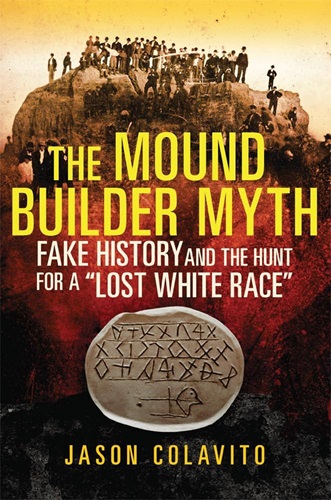
Comprehensive work about the Mound Builder myth – Persons, hypotheses, historical context
The Mound Builder myth is the wrong idea that the Indian mounds in Northern America had been built by some other people than the local Indians resp. their ancestors. There often was a racist motivation behind this belief: If a „lost white race“ had built the mounds which later had been expelled or eradicated by the allegedly newly arrived Indians, then the European colonization and expansion could be perceived as a re-conquest, and the Indians could be perceived as non-native foreigners to their own land. Candidates for the identity of the „lost white race“ were e.g. the Lost Tribes of Israel, Scyths, Celts, Scots, Norsemen, and finally even Atlantis. But also non-white candidates were often driven by racist intentions to delegitimize the Indians. Some thought of Indians from India, and many thought of the Aztecs or Toltecs who allegedly settled in North America first before they allegedly were expelled to Southern America by the newly arrived Indians.
Jason Colavito’s „The Mound Builder Myth“ describes the creation, development, demise, and afterlife of the Mound Builder myth in all detail. The number of authors, hypotheses, and forgeries gathered in this book is amazing. All information is well-documented by 434 notes and eleven pages of bibliography in the appendix. There are thirteen pictures of mounds, authors, or forged stones.
Each development of the Mound Builder myth is paralleled with the respective developments in society and politics. It is well demonstrated that the Mound Builder myth always reflected the current zeitgeist: From the war with Britain, via the war with Mexico, expelling the Indians to the West, the Reconstruction era after the civil war, the mass immigration of Italians, the popularity of eugenics, until postmodernism in the 2nd half of the 20th century. It is amazing to see how the decline of the Mound Builder myth coincided with the decline of the Indian question, and how the myth is revived in later days under completely different perspectives.
Even the foundation myth of the Mormons is based on the Mound Builder myth, and the giants of the Bible were also allegedly found in the mounds.
The core message of Jason Colavito’s book is conveyed with overwhelming evidence: It is obvious that the motivation behind the Mound Builder myth often had been racist and driven by the zeitgeist. This book is a valuable lesson about the direct or indirect interference of politics and public opinion with science or what the public considers science, and how important and effective the resistance of individual dissenters sometimes is, in the long run.
Formal criticism
Right at the beginning of the book a short but comprehensive introduction into the real history of the mounds would have been helpful, especially in order to understand why the connection of the mounds to the contemporary Indians of the 19th century got lost (or to which extent some kind of connection still existed).
The various authors and their hypotheses are presented in a novel-like style. By this approach, order and overview get often lost. The storyline repeatedly goes back and forth in time, and the same authors repeatedly appear in varying roles. The book is divided in only few chapters, and often the content belonging to one chapter, according to its headline, occurs in an other chapter (e.g. important content concerning the giants myth is in the chapter following the giants chapter).
It would have been preferable to have more order and overview in such a complex theme. More speaking headlines, and also subheadlines would have been helpful. At least a table in the appendix listing all authors and their hypotheses, and by whom they where influenced, and whom they influenced in turn. Also a list of the forged stones (what, who, where and when) would provide overview. Also interesting would have been an overview of all persons who continuously held the correct belief that the Mounds were built by the Indians. These were not few, including Martin van Buren, US president 1837-1841.
Last but not least, a map is missing, where all the sites of mounds are marked. Also a map of Ohio or the state of New York could be useful, where the locations of the authors of hypotheses are marked who, as it seems, often lived close to each other and thus easily influenced each other.
The present-day situation is discussed only in the Conclusion, but it really had deserved a chapter on its own.
In the bibliography the book „Hidden Cities“ by Robert G. Kennedy is missing.
It would have been interesting to include some paragraphs about the current official opinion of the various Mormon churches on the origin of the Mormon belief. As I have read, there are not only fundamentalist believers but also more liberal views. How do they live with the truth?
Criticism of contents
While the core message of Jason Colavito’s book is simply true and deserves ardent support, especially when considering the strange revival of the Mound Builder myth in modern TV shows and weird religious fundamentalist or racist circles, there are several problems which may have their origin in a too narrow perspective of the author.
The book does not take seriously enough the legitimacy of 19th century doubts about who built the mounds. As the book itself says, the Mound Builder era ended some 500 years before the Europeans arrived, and the Indian civilization declined (pp. 48 f.). Or the reason for the decline were infectuous deseases contracted by the very first contacts with Europeans, so that except the very first Europeans the Europeans did get to know the Indian civilization only in a declined state (pp. 7, 180). (The book is not clear about which of the two reasons was more important.)
In effect, Indians did not build mounds any more and did not use the mounds as they once had been used. Therefore, it is absolutely understandable that doubts arose when comparing the remainders of the mound building civilization and the state of the civilization of contemporary local Indians. The book repeatedly reports of such doubts (e.g. on pp. 44, 180, 261 f.), but does not take them seriously, although even the famous Frederic Ward Putnam of Harvard thought of the Celts as the Mound Builders (p. 304). Therefore, these doubts should have been examined more carefully. It is not legitimate to talk about the Mound Builder myth as if every proponent of an incorrect explanation had been driven by racism, though often this was the case.
There are several passages in this book where the interpretation of the sources is going beyond what is really contained in the sources in order to make the wanted case.
One example is president Andrew Jackson’s speech of 1830 (p. 116). Andrew Jackson equals the alleged replacement of the Mound Builders by the Indians with the replacement of the Indians by the Europeans. But other than Jason Colavito thinks, the Mound Builder myth does not serve as a racist justification for the replacement of the Indians. Because under a racist perspective, the replacement of the „higher“ race of the Mound Builders by the „lower“ race of the Indians is not justified. The justification expressed by Andrew Jackson is another one. It is simply Social Darwinism: The stronger replaces the weaker. And the case of the Mound Builders serves only as an example, not as a special justification.
Another example is the opinion of the famous German natural researcher Alexander von Humboldt, as expressed in the „Report of the Librarian“ in the Proceedings of the American Antiquarian Society No. 53 of 1869 on p. 42. According to Jason Colavito, Humboldt was „arguing that some Native Americans most closely related to the Mound Builders had been ‚born white‘ before the sun burned them a ruddy copper color.“ (p. 251) – But this is not the case. First, according to the source it is a certain Monsieur de Volney who claims this, and Humboldt is against this claim. Humboldt adds that Mexicans and Peruvians (who were considered related to the Mound Builders by many) are brown by birth. Only the Eskimos and a tribe at the northwest coast are allegedly born white. And then Humboldt calls for verifying the claim of de Volney by just going out and looking at real Indians! This is the spirit of the true scientist and not at all a racist attitude. Especially not in case of Alexander von Humboldt who was an ardent proponent of the idea of human rights.
Another example is Jason Colavito’s reliance (p. 328) on the book „The American West and the Nazi East“ by Carroll P. Kakel, 2011. The book compares the genocidal conquest of eastern Europe by the Nazis with the spread of European settlers in the American West and connected genocidal events – which is grotesque! The Nazis planned their genocidal acts intentionally right from the beginning and conquered Eastern Europe by military force in short time, whereas in the American West, settlers spread slowly over many decades, were confronted with a completely incompatible civilization, and genocidal events unfolded mostly unplanned and unintentionally. Even well-minded intentions towards the Indians played out badly, as Jason Colavito rightly says (e.g. pp. 263-267). – Citations drawn from the book turn out to be taken out of context and their meaning turned upside down. Where Hitler said that America had gunned down the millions of redskins to a few hundred thousands, the context is the following: According to Hitler, the land belonged to the Indians, and the white men have stolen it from them, and the gunning down is depicted by Hitler as a crime. – It is also not true that Hitler was a „massive fan of Westerns“. Hitler watched Westerns, too, but he was not a „massive fan“ of them. Hitler was a massive fan of Disney’s animated cartoon films, especially „Snow White“, as we know today. This book by Kakel is really problematic! You find there many modern myths about the Nazis but not the real history. E.g. Kakel describes the ideologies of Hitler, Himmler and Rosenberg as being on the same line – nothing could be more wrong. Himmler and Rosenberg had severe differences, and Hitler kept clear distance of those two and their ideas. Furthermore, Rosenberg is depicted as „party ideologue“ – which he wished to be but wasn’t. There was only one person defining the Nazi creed and this one person was Hitler, and Hitler, Goebbels and Goering are known to have mocked Himmler and Rosenberg for their fancy ideas.
Criticism concerning the Indian question
The drama of the Indian question is also misrepresented in Jason Colavito’s book. Obviously, Jason Colavito follows a rather romantic perspective of Indians and Europeans living peacefully together on the same land, each of them according to their unchanged traditional culture. This unrealistic multiculturalist idealism becomes clear e.g. by his criticism of Ralph Waldo Emerson’s opinion that the Indians have to modernize (p. 190), or the criticism of the basic intentions of Helen Hunt Jackson and Henry L. Daws (pp. 263 ff.), who wanted to civilize the Indians rather than to expell or kill them. Even Thomas Jefferson wanted to modernize the Indians (pp. 64 f.).
Jason Colavito’s criticism reveals an unrealistic, romantic dream. The European civilization was much more developed than the Indian civilization, so that it was clear right from the very beginning of their contact that the Indian civilization could not survive unchanged. Therefore, the only morally acceptable idea was indeed to develop the Indians to modernity. And here we are right in the middle of the drama: Because, how to repeat the development of European civilization in time lapse? How to modernize the Indians without (!) taking away their Indian identity? And how to civilize a people who partially or totally resisted to be civilized?
It is absolutely understandable that many believed such a civilizing process not possible, and that patience with the Indians ran out, though physically or culturally genocidal acts are also not acceptable, of course. It is really a drama, a problem with no easy solution, a real tragedy, and who knows the outcome if more patient politicians than Andrew Jackson had governed the US in this time. It is not a forgone conclusion that things had played out better, then.
Jason Colavito’s biased orientation in these questions becomes even more clear when he depicts the achievements of human rights as bad for the Indians. He e.g. connects the removal of „all incompatibilities with indiviudalism, and personal liberty“ with the word „destroy“, or he depicts the „redefining of gender roles“ in Indian families as „devastating“. (pp. 265, 267) But human rights are there for all human beings, and finally good for all human beings. The continuation of the patriarchy of the Indian culture, i.e. the systematic suppression of women (and all other family members!) by „old red men“, under the rule of the United States is inconceivable, and is only one aspect of Indian culture which had no chance to survive, and this although the Europeans themselves had still some obvious remainders of patriarchy in their civilization in the 19th century.
Criticism concerning Atlantis
Concerning Atlantis, the book creates the impression that the Atlantis story had „long considered to be fictional“, until the 19th century, and then had been revived by fraudulent Europeans such as Fortia d’Urban (pp. 273 f.). But this is wrong. Atlantis had been long considered real, and what started in the 19th century was not a revival of the idea of a real Atlantis, but quite the opposite: It was the start of the idea that Atlantis had been fictional becoming the prevailing idea.
It is also wrong that „the Spanish“ considered Mexico Atlantis (pp. 273). Only „some“ Spanish thought of Mexico as Atlantis, not „the“ Spanish. The official Spanish position was to reject this idea (e.g. Antonio de Herrera y Tordesillas 1601).
Missing is Francis Bacon’s „New Atlantis“. Here, the Indian civilizations of Southern America are Atlantis, and Plato’s cyclically repeating catastrophes are the reason why the Indians fell down from a higher level of civilization. This would have been an example of Atlantis belief fitting better to reality than usually expected, and it would be interesting to see whether and how Francis Bacon’s view influenced the views of the 18th/19th century.
Ignatius Donnelly is misrepresented as a racist (chapter 11). Of course, Donnelly’s views are partially racist under a modern perspective, but under the perspective of his time, the opposite holds true. Donnelly was a progressive politician, fighting for the abolition of slavery. He even wrote a novel about a white man living like a black and suffering discrimination („Doctor Huguet“, 1891). Furthermore, Donnelly’s Atlanteans were not only white, but also yellow and red, and even excluded some white peoples. According to Donnelly, Europeans were not purely white but a mixture of white and yellow. And in American prehistory, all races of all kinds had met and lived together, as he wrote. Donnelly’s core motivation was clearly not racist although he expressed various racist stereotypes prevailing in his time. The abuse of Donnelly’s work, e.g. by omitting that Donnelly’s Atlanteans are not only white, is much more harmful than the original work itself.
Bewertung: 4 von 5 Sternen.
(Erstveröffentlichung auf Amazon 24. Mai 2020)