
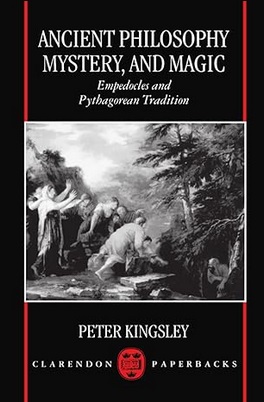
The flow of magical tradition via the Pythagoreans and Empedocles into Near East
This book is very, very worth reading despite certain shortcomings. It starts with realizing that Empedocles was rather a magician and healer than a teacher and philosopher in our modern, rational understanding. Empedocles was deeply rooted in the Pythagorean tradition with all its partly forgotten mystery and magic, and deeply rooted in the mythologies and geo-mythological circumstances of Sicily and the Phlegraean Fields. Orphic poems (Zopyrus, Philolaus, Archytas) and gold plates are closely related to Pythagoreanism. This bigger picture sheds quite a different light than usually known on the achievements of Empedocles and his role in the development of philosophy.
By deciphering the four gods related by Empedocles to his famous four elements, Kingsley unfolds a rich picture of connections and associations in all directions. The streams of fire and water under the earth of Sicily, and the mythological meanings of „craters“ of all sorts, may well indicate that the gods of fire and water are Hades and Persephone, whereas Zeus corresponds to air and Hera to earth. Both are couples by the way, and Kingsley’s view is indeed more convincing than the traditional interpretation of Hades as air (who can believe this?), and Zeus as fire (because of the sun). From Western Greece, the idea that the hell is a burning fire made its career into the Near Eastern religions. And by „planetarizing“ of the traditional view of certain „layers“ of earth and fire under our feet, Philolaus created under Homeric and Babylonian influence the idea of a central fire, thus deviating from geocentrism. Philolaus‘ view became lost again in some later Pythagorean thinkers, and Plato.
As Kingsley demonstrates, Plato has taken over certain Pythagorean and / or Orphic myths and presented them in the framework of his own philosophy. The Phaidon myth reflects quite obviously the geomythology of Sicily and the Phlegraean Fields. Plato did not just invent his myths, as many believe today, and informed his readers correctly about his sources. Plato and Aristotle are depicted as the „protestants of Pythagoreanism“, i.e. skeptic and rational. Even only to get a better understanding of Plato and his context makes this book worth reading.
Via Hellenistic Egypt, the ideas of Empedocles found their way into Near Eastern mythology in form of magical, hermetical, and alchemical texts, and finally made their way into Islamic philosophy and Sufism. It is true that Islamic philosophy sees magical aspects of Empedocles which have been forgotten or misunderstood by the rational Aristotelean tradition in the West, and it is nicely demonstrated how a thin line of Western thinkers reconstructed this lost tradition by contact to the East.
What is more, some Sicilian and Pythagorean ideas came originally from Babylon and were transported by Greek colonists from Anatolia settling in Western Greece. And Pythagoras allegedly studied in Egypt. Also the use of gold plates came from Egyptian traditions, with the Carthaginians, as Kingsley claims. And behind all, there are traces to Asiatic shamanism.
This is only a short outlook on few of the many details and insights this book offers to its readers. The number of substantial and evidence-based statements is high, as well as the number of valuable stimuli, from which you could start research in many directions. You really delve into the atmosphere of the mysterious world of Empedocles and the Pythagoreans in Western Greece, and start to create a first understanding of a lot of connections in the history of ideas of which you even did not know that they could exist.
Criticism
You cannot buy everything what Kingsley writes. Clearly, Kingsley has a point, more than only one point. He is clearly more right than wrong. Especially in the field of Empedocles, Sicily, the Pythagoreans, and their time. The more he steps into the world of magic and away from Sicily, the more speculative and intransparent the picture becomes. But if only 50% of Kingsley’s claims will survive the scrutiny, it will nevertheless be a great book. So, read it!
After realising, that Pythagoreanism is no unique dogmatic teaching, it becomes a big problem where to draw the line between a „real“ Pythagorean, and someone who is only „influenced“ by Pythagoreanism, and by related mystery movements such as Orphism, gold plates, Heraclean cults, hermetism, alchemism, etc. Kingsley demonstrates the problem but does not present a solution. The lines are often too blurred.
Kingsley does not only describe a magical world view but also seems to have a tendency to side with it against rationality. This is not acceptable. It is true that Empedocles was no „pure“ philosopher, or not a „rational philosopher“ at all in his own eyes, yet it is wrong to deny a process of rationalization. It is not necessary that Empedocles as a link in the chain of rationalization was aware of being such a link. Despite the author’s dissent, there was indeed an evolution of rationality. It is natural, that when rationality starts its way in a world of myth, it overcomes myth only step by step, and still works with myth, in an eternal process of progress. Even today, our thought is not fully free from myth, and it never can be. Of course, the boundaries of myth have been pushed far to the horizon, in our days, but myth is still there.
And it was good that this evolution of rationality happened. Progress in rationality is indeed progress. We clearly have to make this value judgement. Therefore, it was no progress and not good that after Plato and Aristotle Neoplatonists and irrational „thinkers“ like Numenius took over. It does not help that Neoplatonists had a better understanding of some aspects of Empedocles than Aristotle had, and that they partially got this knowledge from a line of tradition parallel to the known rational tradition. One and the same semi-rational attitude means progress when rationality is on the rise, and regression when rationality is stepping back. Although Empedocles may have been equally semi-rational as was Numenius, it is not the same, and Numenius‘ antics were not good.
That late Pythagoreans, Plato, and Aristotle rationalized ancient myths in a wrong way is not the fault of rationality, as Kingsley repeatedly claims, but of a lack of information. Kingsley’s book itself is an example how you can depict things better in a rational way. Plato and Aristotle do not have to step aside with their rationality.
Strange enough, Kingsley, who accuses Plato and Aristotle of having misinterpreted Empedocles because of their rationality, himself misinterprets Plato, obviously because he is at odds with rationality: It is clearly wrong that the line between logos and mythos is blurred in Plato’s dialogues. Contrary to this erroneous opinion, held by many contemporary scholars, logos and mythos are very sharply separated in Plato’s works. They are combined but never mixed. And how can Kingsley who clearly realized that Plato did not just invent his myths, draw an analogy of the creator of the universe and Plato as the creator of myths, and cite Luc Brisson? It would have been helpful to outline the difference between mythos and myth, but Kingsly does not discuss this basic problem. Furthermore, it does not help that Kingsley sees irony everywhere in Plato’s works where there is none. So many mistakes in interpreting Plato are built upon the „feeling“ of irony. Kingsley really could have done better. Does Kingsley have a pathological strive for the irrational? In these passages about Plato’s myths, Kingsley’s book is a superfluous repetition of academic postmodern commonplace errors.
Furthermore, the author is too skeptical towards established science. Of course, academics have made and still make many things wrong. But they are more open for alternative ideas than many think. The author should have tried to build some golden bridges to come together. But maybe the stubborness of established academia is felt more deeply if you depend on it to make a living?
Partly, the style of writing as a story of discovery became boring after a while. A more straightforward and ordered presentation of the material sometimes would have been more helpful. But in any case, you have to make your own notes when reading such a book. Do not read this book without!
Finally, I clearly do not like the bad image of Cicero depicted by Kingsley. Plato, Aristotle, and Cicero have to be praised in the first place, whereas the irrational radicalism of „thinkers“ such as Numenius has to be put under scrutiny.
Bewertung: 4 von 5 Punkten.
(Erstveröffentlichung auf Amazon am 14. November 2017)
Schreibe einen Kommentar