Ingenious description of life and customs on Sicily
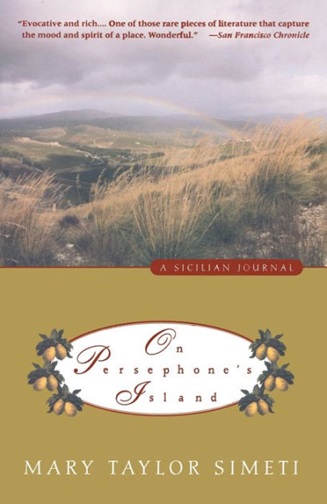
As a young student from New York Mary Taylor Simeti came to Sicily, fell in love, married and lived her life on the island as an expatriate. This means she is in the double-role of an insider and an outsider and thus the perfect reporter on atmosphere, life and customs on Sicily, far better than any journalist traveling around for some months.
The book is organized following the seasons of the year thus showing the close relationship of life on Sicily to nature. Farming, plants, flowers, climate, public holidays and harvesting are important parts of her life. But the author also writes about her husband’s family and how she integrated step-by-step into the Sicilian society. Greek mythology does not play a central role but it is interesting to see how the author makes practical use of otherwise only academically treated myths. Life with the silent presence of the Mafia is a topic as well as customs like Easter processions and the widely unknown virgineddu. As an American the author wonders how Sicilians organize themselves, such as concerning her children’s school or how to get entrance to a historical building on a military site.
The book covers the time of the 1970s and 1980s and shows many features of the time: The author came to Sicily to support Danilo Dolci driven by a somewhat romantic social idealism, then we read again and again how she marched in demonstrations against American missiles on Sicily, or against the Mafia, or to protect a natural reserve. The author declares to be glad that anti-communism lost its strength. Old fotographs on the Web site of her winery „Bosco Falconeria“ show the typical beards and clothings of leftist students around 1968. From today’s point of view (2013) this does not seem so political any more but rather like folklore of these times in a certain social milieu. All in all Mary Taylor Simeti did not strive for communism but lived a good life as owner of several houses in Palermo and Alcamo and of course the farm Bosco Falconeria near Palermo, and she lets us readers take part in the sufferings and rewards of such a Sicilian life. Thank you!
PS 18.11.2024
Being grown up in a rural area in southwest Germany, I observed some striking similarities: There is e.g. the religious procession of the local saints. Then, the harvesting with the help of he entire family. And even the technicalities of the fruit press are similar, only, that in Sicily it is all about olives, while in Germany is is about apples and pears. And of course, there is more sun than in the rest of the country. It seems that „southern Catholic provinces“ are everywhere the same.
Bewertung: 5 von 5 Sternen.
(Erstveröffentlichung auf Amazon am 07. Februar 2013)