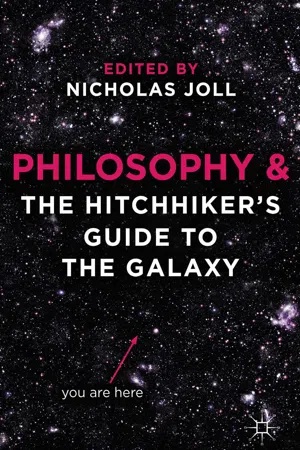
Mostly exciting discussions of philosophical ideas in the Hitchhiker’s Guide
This book fulfills the expectation that all the philosophical topics which made you stop, smile and think for a moment, while reading Douglas Adams‘ Hitchhiker’s Guide to the Galaxy (and it’s follow-ups), are picked up and discussed. The topics are presented with a certain fun factor, since the authors partly tried to emulate Douglas Adam’s style of writing, and since serious philosophical problems are discussed on the background of the rather funny Hitchhiker’s world. Last but not least, the presented philosophical topics are for themselves mostly exciting, though you may have heard already of some of them.
Warning: For me, the book seemed to start rather dry and boring in its first chapters. But it gained momentum in the middle of the book and turned out to be an exciting and funny read in the end. Maybe it’s due to my own philosophical views and preferences? Anyway, if it happens that you find the book boring, keep on reading, it will change!
Some interesting topics / discussions (it is even more):
- Is it allowed to eat animals if they give consent?
- Is it allowed to enjoy violence if it’s only virtual reality?
- The meaning of Life under the perspective of an infinite life / a finite life.
- The absurdity of life and how to handle it.
- The mere existence of God and being part of his plans is not sufficient to give meaning to our life.
- Artificial Intelligence: Self-feeling and the relation of feeling and reason as a problem.
- Reason does only work if we have feelings, too. (p. 137)
- Some philosophers consider it even likely, that we exist in a computer simulation, and in fact only somewhere in the middle of a computer-simulation-within-a-computer-simulation hierarchy of nested computer simulations.
- Some philosophers consider it possible that our world had been constructed only for the purpose of performing a certain simulation / calculation, just like the Earth in The Hitchhiker’s Guide.
- Kurzweil’s idea of transhumanism is clearly put into question.
- Parallel universes and multi-universes.
- There’s also an exercise in logic.
- The ruler of the universe as a Pyrrhonian skeptic.
- The „Judo principle“: Instead of solving a problem directly, use the problem to solve itself! There are many well-known applications of the Judo principle in various areas of philosophy, and it is interesting to see how these well-known arguments work all along the same principle, and where the limits of the principle are.
- Kant’s critique of pure reason as an application of the Judo principle, in answer to another application of the Judo principle by David Hume.
- The „logic of jokes“ is closely related to the logic of philosophising, i.e. surprise, wonder, brainstorming, bringing together what seems not to belong together, etc.
- Inspiration of The Hitchhiker’s Guide by Swift’s Gulliver’s Travels, and especially by Voltaire’s Candide.
Some of the chapters slightly overlap in their topics, since they are written by various authors, but this is not a problem since it makes you rather think twice about a problem from a slightly different perspective. All chapters provide useful and not too many hints to literature. There is a glossary of philosophical terms, too, and various indices on topics within and without The Hitchhiker’s Guide to the Galaxy.
Missing or insufficiently discussed are e.g.:
- Political philosophy in The Hitchhiker’s Guide.
- Relation of religion to politics, or to other-believers, or to non-believers, and vice versa.
- Development of human society step by step.
- The event of changing mind; religious reforms.
Bewertung: 4 von 5 Sternen.
(Erstveröffentlichung auf Amazon am 10. März 2019)